
Housing & Cage Setup · 9 min read
Pet Hedgehog Cage: The Setup That Actually Works
Most pet-store hedgehog cages are too small, unheated, and come with the wrong wheel. The cage, heat, substrate, and gear experienced owners actually use.
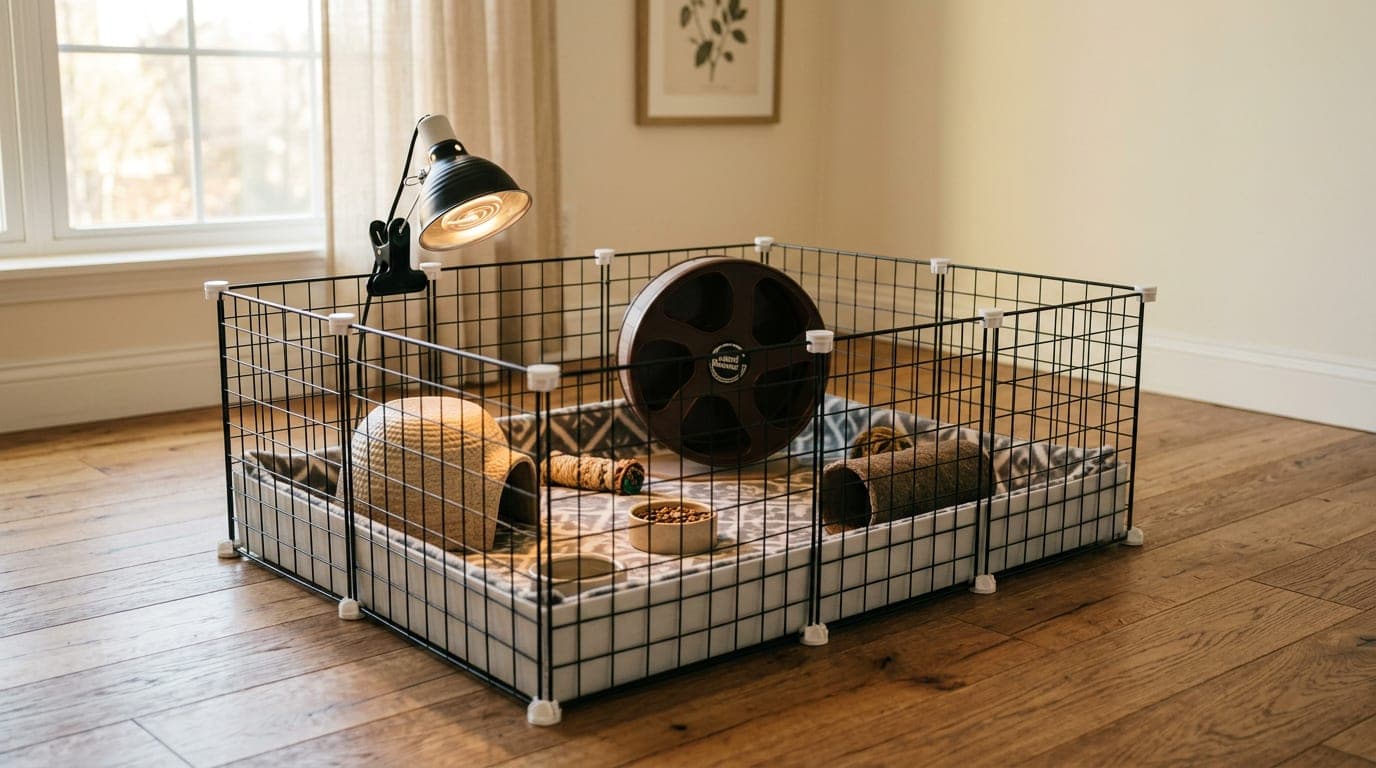
C&C grid setup — heat lamp + fleece liner + silent wheel + covered hide
The cage you buy at a pet store is almost always the wrong cage. It's typically too small, has no heat source, comes with the wrong wheel (often a wire-rung one that injures feet), and includes substrate that's either useless (cellulose pellets that get kicked everywhere) or actively harmful (cedar shavings, which are toxic). The good news: building the right setup is straightforward once you know what each piece does and why.
Plan for $200–400 for a complete first-time setup. That feels like a lot until you've tried to fix the consequences of a $60 starter kit at the vet. We'll walk through every component below.
The minimum cage size. And why "minimum" isn't the goal
A single adult African pygmy hedgehog needs at least 4 square feet of floor space. That's roughly 24×24 inches, or 60×60 cm. Most experienced owners give 6+ sq ft.
Why size matters: hedgehogs in the wild cover several kilometers a night foraging. Captive hedgehogs without enough space don't replicate that activity even with a wheel. They pace, develop stereotypic behaviors, gain weight, and live shorter lives. The 4 sq ft minimum is what allows a wheel + hide + food + water + a meaningful walking area to coexist without crowding.
The cages most pet stores sell as "starter kits" or "complete hedgehog setups" are typically 2–3 sq ft. They're priced around $50–80 and they're not adequate. They were designed for hamsters and re-marketed for hedgehogs. If a pet-store employee insists otherwise, they're wrong; this is one of the most reliable bad signals about a pet store's expertise.
Floor space matters more than vertical space. Hedgehogs can climb (they're surprisingly capable on cage bars and ramps) but they're bad at it. Falls from heights are a leading cause of preventable injuries. Broken legs, internal injuries, sometimes fatal. Single-level cages with maximum floor area are safer than multi-level setups with the same total square footage.
The cage types most owners settle on
Three options dominate. Each has tradeoffs.
C&C grids (Cubes & Coroplast)
The flexible, customizable, owner-built option. Wire grids (the kind sold for storage cubes) bolted together into a rectangle, with a corrugated plastic (coroplast) sheet on the floor.
- Cost: $40–80 for grids + $20–40 for coroplast. Total ~$60–120 for a 6 sq ft cage.
- Pros: Fully customizable size and shape. Easy to expand. Excellent ventilation. Cleans up well.
- Cons: Open top (cats and dogs can access). Some assembly required. Less visually polished than commercial cages.
This is what most experienced owners build. Search "C&C hedgehog cage" for assembly tutorials. It's a 1-hour project.
Midwest Guinea Habitat (and similar large guinea pig cages)
Pre-made commercial option. ~8 sq ft floor space, soft fabric sides, removable for cleaning.
- Cost: $100–150 new.
- Pros: Comes assembled. Larger floor than most "hedgehog" cages. Easy to clean (the bottom flips up).
- Cons: Open top. Soft sides can be chewed. Not as durable as C&C.
A solid second choice, especially if you want a one-purchase solution.
Custom enclosures (IKEA hacks, vivariums, custom builds)
The advanced option. Some owners convert IKEA Detolf display cases (laid horizontally) or build wooden enclosures with sliding glass fronts.
- Cost: Varies wildly. $80 (Detolf) to $400+ (custom build).
- Pros: Closed top (cat-safe, draft-resistant). Can integrate heat lamp mounting. Looks like furniture.
- Cons: Significant DIY effort. Heat and humidity build up faster in enclosed spaces. Needs more careful ventilation planning.
Worth the work if you have the skills, but not necessary. C&C does the same job for less effort.
What to skip
- Glass aquariums. Poor ventilation, heavy, hard to clean, and most "large" tanks (40-gallon, 75-gallon) are still under-sized. Skip.
- Hamster cages. Too small. The bars are usually too narrow for adequate airflow.
- Wire-bottom cages. Hedgehog feet get stuck in wire. Uses include "never."
- Multi-level "rabbit" cages. Falls from upper levels cause injuries. Stick to single-level.
Heat: the most-overlooked thing
This is the section that prevents the most deaths. African pygmy hedgehogs evolved in sub-Saharan grasslands. They need 72–80°F constant ambient temperature, year-round. Below 70°F they may attempt to hibernate, which captive African pygmies cannot complete safely. Many die during the attempt.
Most US homes don't maintain 72–80°F overnight, especially in winter. The home thermostat says 70°F because that's what most humans want; hedgehogs need warmer. Supplemental heat isn't optional in most climates.
The standard setup
A ceramic heat emitter (CHE) bulb in a clamp lamp, mounted above the cage, controlled by a thermostat.
Each component:
- Ceramic heat emitter (CHE): A bulb that emits heat but no visible light (so it doesn't disrupt sleep cycles). 60W is appropriate for most cage sizes; 100W for larger spaces. Cost: $15–25.
- Clamp lamp with ceramic socket: A reflector-style work light, but with a ceramic socket (not plastic. CHEs run hot enough to melt plastic sockets). Mounted above the cage so the bulb is 6–10 inches from the highest part of the cage. Cost: $15–25.
- Thermostat: Plugs into the wall, then the lamp plugs into the thermostat. The thermostat probe goes inside the cage. When cage temperature drops below your set point, the thermostat turns the lamp on. Above the set point, off. This is the single most important component. Without a thermostat, the heat lamp either runs constantly (overheats) or you have to manually monitor. The Inkbird ITC-308 is the standard recommendation. Cost: $35–50.
Total heat setup cost: $65–100. Non-negotiable.
What to skip for heating
- Heating pads under the cage: Create a hot spot in one location while the rest of the cage stays cold. Don't reliably warm ambient air. Acceptable as a secondary heat source for a hide; not adequate as the primary heat.
- Snuggle Safe disks (microwaved heat disks): OK for transport in a carrier. Not adequate as a 24/7 heat source.
- Space heaters in the room: Acceptable as supplemental heat for the room, but you still need cage-level temperature control. Space heaters in the cage area can also become a fire risk. Keep them well clear of cage materials.
- Incandescent bulbs: They emit visible light, which disrupts the hedgehog's day/night cycle. Use a CHE specifically.
Substrate: what goes on the cage floor
Two main camps: fleece liners (washable fabric) and loose substrate (shavings, paper, etc.). Most experienced owners use fleece. Here's why.
Fleece liners (recommended)
Fleece fabric cut to fit the cage floor, used like a fitted sheet. Wash weekly.
- Pros: No respiratory issues, no risk of feet getting tangled, easy to spot-clean, reusable for years.
- Cons: Some hedgehogs try to burrow under it (solvable with a few clips at the corners). Doesn't allow natural digging behavior.
- Cost: $15–25 for a few cuts. Reusable indefinitely.
The "hedgehogs need to dig" objection is mostly overstated. Most pet hedgehogs on fleece do fine; if you want to allow some digging behavior, add a digging box (a small container of organic soil or fleece scraps) as enrichment.
Aspen shavings (acceptable)
Wood shavings made from aspen (NOT cedar, NOT pine).
- Pros: Natural-looking. Allows some digging behavior.
- Cons: Dust can cause respiratory issues. Sticks to hedgehog feet and quills. Has to be fully replaced regularly.
- Cost: $10–20 per bag, replaced every 1–2 weeks.
Aspen is the only wood shaving we'd consider acceptable. Cedar contains aromatic oils that are toxic to small mammals; pine is controversial (kiln-dried is safer but still not ideal). If a bag doesn't specifically say "aspen" or "kiln-dried pine," skip it.
Paper-based substrate (carefresh, etc.)
Recycled paper pulp. Sold under brands like Carefresh, Kaytee Clean & Cozy.
- Pros: Low dust, absorbent, no toxicity concerns.
- Cons: Expensive over time. Some hedgehogs find it less satisfying than fleece or shavings.
- Cost: $15–25 per bag, replaced every 1–2 weeks.
Acceptable middle ground if you're not sold on fleece.
What to skip
- Cedar shavings. Toxic. Avoid entirely.
- Pine shavings (non-kiln-dried). Same family of concerns as cedar, less severe but still avoidable.
- Cat litter (any type). Dusty, can be ingested, sometimes contains additives that are problematic.
- Newspaper alone. Inks can stain, no insulation, doesn't absorb well.
Cage layout. What goes where
Inside the cage, you need:
A covered hide. Single small entrance, fully enclosed top. A ceramic igloo, a wooden hut, or even a sturdy cardboard box works. Hedgehogs prefer hides they can fully disappear into. One per cage; some owners use two for variety.
A wheel. 12-inch minimum diameter. The standards are the Carolina Storm Wheel ($45) and the Bucket Wheel ($30). Both are solid-running surface (not wire), silent or near-silent, and easy to clean. Position the wheel away from the food/water area. Hedgehogs poop on the wheel, and you don't want that landing in their food.
Food and water dishes. Small ceramic bowls, heavy enough not to tip. Many owners offer both a water bowl and a water bottle; the hedgehog picks one and ignores the other (which one varies by individual). Position both somewhere the wheel-poop pattern doesn't reach.
Optional: a digging box. A small plastic container with a shallow layer of organic soil or shredded fleece scraps. Some hedgehogs use it; some ignore it.
Optional: enrichment. Toilet paper rolls (one end snipped open so a hedgehog can't get stuck), small soft toys without removable parts, a snuffle mat. Most enrichment lasts a few weeks before the novelty wears off. Rotate.
A useful general principle: more empty floor space is better than more "stuff." A hedgehog that has room to wander is happier than one whose cage is a cluttered playground.
What to skip. Common bad gear
- Exercise balls. Hedgehogs aren't built for them. Their feet slip through the air slits, they overheat fast in the enclosed space, and they have no way to communicate distress. Don't.
- Leashes and harnesses for hedgehogs. Marketed as "hedgehog walking" gear. Hedgehogs don't walk on a leash; the harnesses don't fit the body shape; the whole concept is solving a problem hedgehogs don't have.
- Multi-hedgehog cages designed for "pairs." Hedgehogs are solitary. Don't house two together.
- Cute plastic accessories with small detachable parts. Hedgehogs chew. Detachable parts are choking hazards.
Expected cost. First-time setup
Realistic budget for a first-time owner getting a single adult African pygmy:
| Component | Cost |
|---|---|
| Cage (C&C grids + coroplast) | $60–120 |
| CHE bulb (60W) | $15–25 |
| Clamp lamp with ceramic socket | $15–25 |
| Thermostat (Inkbird ITC-308) | $35–50 |
| Wheel (Carolina Storm or Bucket) | $30–45 |
| Hide (igloo or wooden) | $10–25 |
| Food & water dishes (ceramic) | $10–20 |
| Fleece liners (3–4 cuts) | $15–25 |
| First bag of kibble | $10–25 |
| Initial insect supply | $10–20 |
| Thermometer/hygrometer | $10–15 |
| Total | $220–395 |
This doesn't include the hedgehog itself ($150–300 from a reputable breeder, sometimes free from rescue) or the first vet visit ($80–150).
The temptation to economize is strong. The mistake is almost always in the cage size and the heat setup. Both of which cause real problems if cut. Better to wait two weeks and save another $100 than to start with an under-sized cage and an inadequate heat setup.
Setup sequence. What to do in what order
The night before your hedgehog arrives, the setup should be running and stable:
- Build the cage (1–2 hours for C&C, 30 minutes for Midwest)
- Mount the heat lamp and thermostat. Set the thermostat to 75°F. Let it run for 4–6 hours. Confirm with a separate thermometer that the cage is actually 75°F (not 65, not 85).
- Add substrate. Fleece liner cut to size, or 1–2 inches of aspen/paper shavings.
- Place the wheel, hide, food and water dishes in their final positions.
- Pre-fill the food and water so they're ready before the hedgehog arrives.
- Verify the cage is in a quiet, draft-free location that's not in direct sunlight, not next to a heating/cooling vent, and not in a high-traffic area.
When the hedgehog arrives the next day, place them gently in the cage, leave them alone for 4–6 hours (they need to acclimate), then offer their first feeding from your usual spot. Don't try to handle them for at least the first 48 hours.
The first week is mostly about leaving them alone. Resist the urge. Patience now pays off in months 2–6, when the hedgehog has settled and is comfortable being handled.
Common questions
Common questions
What's the smallest cage I can use?
4 square feet of floor space (~24×24 in) is the absolute minimum for a single adult. 6+ sq ft is better. Single-level cages are preferable to multi-level — hedgehogs can climb but they're bad at it, and falls cause injuries. The pet-store starter cages sold next to the hedgehogs are typically 2–3 sq ft and almost always too small.
Do I need a heat lamp?
Yes, in almost every climate. A ceramic heat emitter (CHE) on a thermostat is the standard setup. Heating pads alone can't maintain ambient air temperature reliably and create cold spots. The exception is rare: if you live somewhere your home stays consistently 75°F+ year-round and you can prove it with a thermometer, you might get away without supplemental heat.
Can I use a glass aquarium?
Not as a primary cage. Glass tanks have poor airflow (humidity and ammonia build up), are heavy and hard to clean, and most adult hedgehogs need more floor space than a standard 40-gallon tank provides. Use C&C grids or a Midwest Guinea Habitat instead.
What about wood shavings?
We don't recommend cedar (toxic) or pine (controversial — kiln-dried is safer but still not ideal). Aspen is the best wood option if you must use shavings. Most experienced owners use fleece liners instead — washable, no respiratory risk, no risk of getting tangled in feet.
Do hedgehogs need a wheel?
Yes — non-negotiable. Wild hedgehogs cover several kilometers a night foraging. A captive hedgehog without a wheel will gain weight, become depressed, and shorten their lifespan. 12-inch silent runners (Carolina Storm, Bucket Wheel) are the standard. Avoid wire-rung wheels and any wheel under 11 inches.
How often do I clean the cage?
Spot-clean daily (poop on the wheel, anywhere obvious). Full cage clean weekly: wash the fleece liner, scrub the wheel, refresh hides, sanitize food/water dishes. Most owners settle into Sunday or whatever day works for their schedule.
Related on this site
Every guide in Housing & Cage Setup
Sources
Sources
- Cedar wood toxicity in small mammals — review — PubMed
- Husbandry and Nutrition of Insectivorous and Omnivorous Mammals — Veterinary Clinics of North America: Exotic Animal Practice