
Housing & Cage Setup · 6 min read
Hedgehog Bedding: What Actually Works (and What's Toxic)
Fleece liners, aspen shavings, paper bedding — what to use, what to skip, and which 'natural' substrate is actually toxic to hedgehogs.
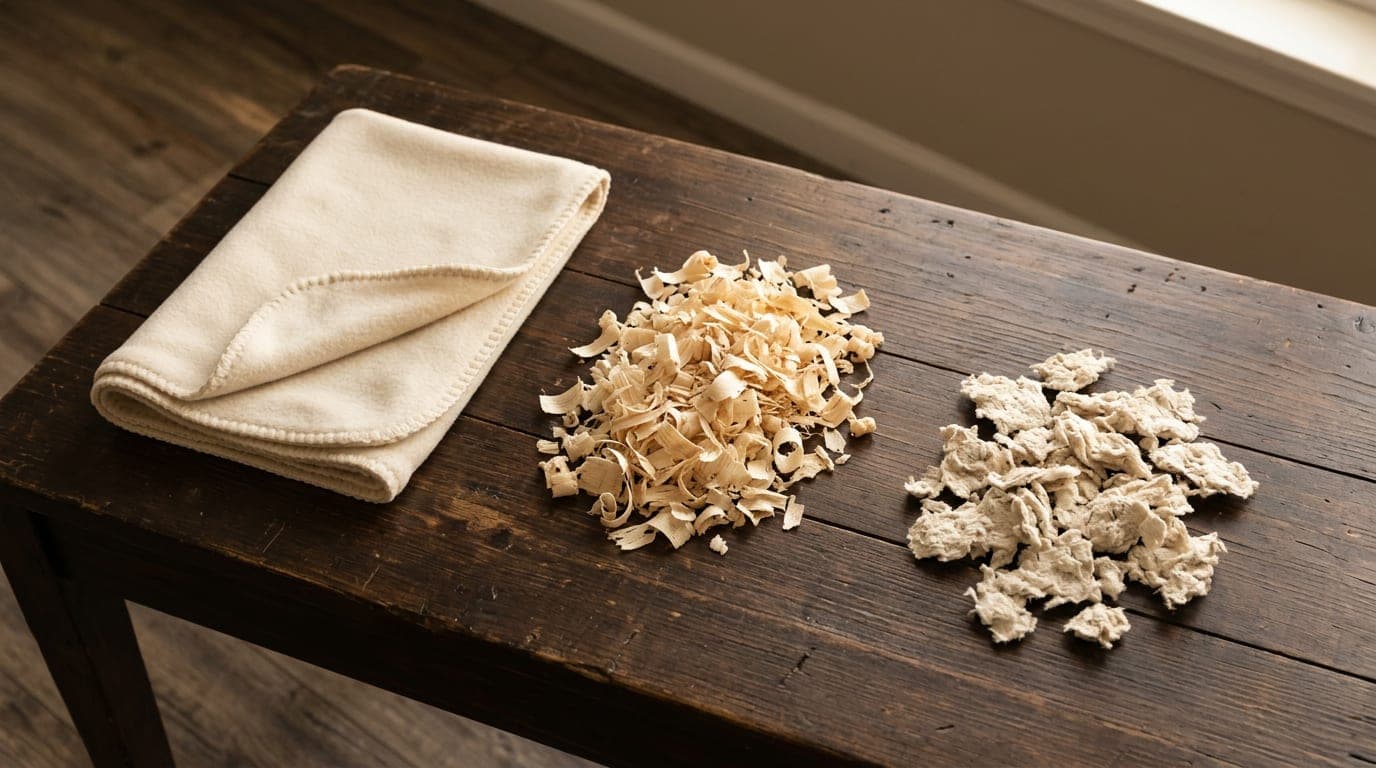
The three substrates worth considering · fleece, aspen, paper-pulp
The substrate at the bottom of a hedgehog's cage matters more than it sounds. The wrong one (cedar, certain pine, anything scented) can cause liver damage. A merely inadequate one (corn cob, cat litter, towels) causes everything from respiratory issues to caught toenails. The good news: there are three substrates that experienced owners reliably settle on: fleece liners, aspen shavings, and paper-pulp bedding. And the differences between them are mostly about what you find easier to maintain.
Most experienced owners we know have ended up on fleece liners. We'll explain why, and also explain when one of the other two is the better call.
The three substrates worth considering
Fleece liners (what we'd recommend by default)
Fleece fabric cut to fit the cage floor, used like a fitted sheet. Washed weekly.
Pros:
- Zero respiratory risk: no dust at all
- Reusable for years. Buy once, wash forever
- Easy to spot-clean: wipe off visible poop with a baby wipe or paper towel between deep cleans
- Smooth. No snag risk for toenails
- Cheap over time. $15–25 for a few cuts that last 2–3 years
Cons:
- No "natural" digging behavior (most hedgehogs adapt fine; the rest get a digging box)
- Some hedgehogs try to burrow under the liner (solvable: clip the corners to the cage with binder clips)
- You'll see every drop of poop, which feels like more mess than it is. It's the same amount, just visible
Cost: $15–25 upfront. Lasts 2–3 years.
Best for: First-time owners, anyone with respiratory issues, anyone who doesn't want to keep buying substrate.
Aspen shavings (the only safe wood option)
Wood shavings made from aspen. Sold at most pet stores in the small-mammal aisle.
Pros:
- Allows natural digging behavior
- Looks more "wild" than fleece, if that matters to you
- Easy to find. Most pet stores stock aspen
Cons:
- Dust from the shavings can cause respiratory issues over time, especially for hedgehogs with pre-existing lung sensitivity
- Sticks to hedgehog feet and quills: daily picking-out
- Has to be fully replaced every 1–2 weeks. Ongoing cost
- Some bags are mislabeled or mixed (we've seen "aspen" bags that smell strongly of cedar. Return them)
Cost: $10–20 per bag, replaced every 1–2 weeks. ~$30–50/month.
Best for: Owners who specifically want to allow digging behavior and have a hedgehog without respiratory issues.
Critical: Make sure it's actually aspen. Some pet-store house brands label everything as "small animal bedding" without specifying species. Check the bag specifically says aspen. Cedar and unkiln-dried pine in the same aisle look almost identical.
Paper-based bedding (the middle ground)
Recycled paper pulp, sold under brands like Carefresh and Kaytee Clean & Cozy.
Pros:
- Low dust (most brands)
- Absorbent. Handles spills and pee well
- No toxicity concerns
- Allows some digging behavior
Cons:
- Expensive over time. Costs more per cubic foot than aspen
- Some hedgehogs find it less satisfying to dig in than wood shavings
- Color additives in some brands (the "rainbow" Carefresh) are unnecessary and we'd skip
Cost: $15–25 per bag, replaced every 1–2 weeks. ~$40–65/month.
Best for: Owners who don't like fleece (some find it too much like a "dishrag" cage) but want to avoid wood-dust issues. Also a reasonable option for hedgehogs prone to skin irritation, since paper bedding tends to be the gentlest on the skin.
What to skip. The actively bad options
Substrates we'd actively recommend against:
❌ Cedar shavings (toxic)
Cedar contains aromatic phenols that are documented to cause liver damage and respiratory irritation in small mammals. The damage is cumulative. Short-term exposure may not show symptoms, but long-term use shortens lifespan and complicates other illnesses.
This is one of the few substrates we'd call "actively dangerous." If you have a bag of cedar shavings, either return it or use it for something other than animal bedding (it's fine in closets and gardens). Don't keep using it because you already bought it.
❌ Pine shavings (controversial. Skip the unkiln-dried version)
Pine contains similar aromatic oils to cedar, in lower concentration. Kiln-dried pine has had most of these driven off and is considered safer than untreated pine. Even so, most experienced owners skip pine entirely because aspen is available, costs the same, and doesn't have the asterisk.
If a bag doesn't specifically say "kiln-dried," assume it isn't.
❌ Cat litter (any type)
Cat litters are designed for an animal that doesn't roll around in them. Hedgehogs do. The dust is harsher than wood shavings, the clumping action can clog hedgehog feet if wet, and any cat-litter additive (deodorizers, antibacterial agents) is not safe for hedgehogs to ingest while grooming.
This includes "natural" cat litters made from corn or wheat. Same concerns at smaller scale.
❌ Corn cob bedding
Sold in some pet stores as "small animal bedding." Three problems: it can be ingested and cause intestinal blockages, it grows mold quickly when wet, and the kernels are too hard to be comfortable to walk on. Skip.
❌ Towels (loop fabric)
Towel loops snag hedgehog toenails. We've personally seen multiple cases of injured nails or torn toes from towel bedding. If you want a fabric option, it has to be smooth-faced fleece, not toweling.
❌ Sand, dirt, or anything wild-collected
Sand can cause GI issues if ingested while grooming. Wild dirt carries parasites and possible pesticides. There's no benefit either provides over the safe options above.
❌ Anything scented
Scented bedding (cedar-scented pine, "fresh garden" Carefresh, lavender-anything) usually means added artificial fragrance, which can cause respiratory issues. Unscented versions of any acceptable substrate are always better.
Quick comparison
| Substrate | Safe? | Cost (monthly) | Maintenance | Best for |
|---|---|---|---|---|
| Fleece liners | Yes | ~$0 (one-time $15–25) | Weekly wash | Most owners |
| Aspen shavings | Yes (verify label) | ~$30–50 | Replace 1–2 weeks | Diggers, no respiratory issues |
| Paper-pulp bedding | Yes | ~$40–65 | Replace 1–2 weeks | Sensitive skin, dislike fleece |
| Cedar shavings | No (toxic) | : | . | Skip entirely |
| Pine shavings (non-kiln-dried) | No | : | . | Skip |
| Cat litter | No | : | . | Skip |
| Corn cob | No | : | . | Skip |
| Towels | No (snag nails) | : | . | Skip |
| Sand or wild dirt | No | : | . | Skip |
Switching substrates
If you've been using something we'd recommend against (especially cedar), switch immediately. Don't try to "use it up". Discard the rest and replace.
If you're switching between two acceptable substrates (e.g. moving a hedgehog from aspen to fleece), do it gradually if possible. Ideally during a deep clean, with the new substrate set up in the freshly-cleaned cage. Some hedgehogs are mildly stressed by sudden environmental changes; gradual transitions reduce that.
The hedgehog will let you know if a substrate isn't working: scratching at the new bedding obsessively, sneezing more than usual, dry-skin patches developing, or simply refusing to settle. Most healthy hedgehogs adapt to any of the three good substrates within a few days.
What to use under the substrate
The cage floor itself matters separately from the bedding. For C&C cages, a coroplast (corrugated plastic) sheet is the standard. Waterproof, easy to wipe down, lasts indefinitely. For Midwest Guinea Habitats, the included canvas bottom works fine and can be lifted out for cleaning.
What not to use as a cage floor: bare wood (absorbs urine, hard to clean), bare wire (toes get stuck), or anything porous like cardboard.
Substrate goes on top of the floor. Fleece liners cover the whole floor. Loose substrate goes 1–2 inches deep. Enough for the hedgehog to nose around in but not so deep that they get lost.
A note on cleanliness expectations
A hedgehog cage smells. Not strongly, if you're keeping up with cleaning, but there's always an ambient warm-animal smell that no substrate fully solves. If you can smell the cage from across the room, something's off. The substrate is overdue for a change, the wheel hasn't been cleaned, or there's a hidden poop you haven't found yet.
If you can't smell it from a foot away, you're probably fine. Hedgehogs are clean animals; the smell of a well-maintained cage is faint and warm, not unpleasant.
Common questions
Common questions
Are wood shavings bad for hedgehogs?
Cedar shavings are actively toxic — the aromatic oils cause liver and respiratory damage in small mammals. Pine is controversial; kiln-dried pine is safer than non-kiln-dried but still not ideal. Aspen is the only wood shaving most experienced owners consider safe. The dust from any wood shaving can cause respiratory issues, which is part of why fleece liners have become the standard.
Why do most owners use fleece liners?
Three reasons: zero respiratory risk (no dust), reusable for years (washable), and easier to spot-clean than loose substrate. The downside is that you can't see digging behavior, which some hedgehogs enjoy — but that's solvable with a small digging box as enrichment.
How often do I change the bedding?
Fleece liners: weekly for the deep clean, plus daily spot-cleaning. Loose substrate (aspen, paper): full replacement every 1–2 weeks for most cages, more often if you have multiple animals or a heavy-poop hedgehog. Always remove visible mess as you spot it.
Can I use towels instead of fleece?
Skip towels. The looped fabric snags hedgehog toenails — we've seen multiple injuries from this. Fleece is smooth-faced and snag-free.
What about natural substrates like coconut coir or aspen pellets?
Coconut coir holds too much moisture and encourages mites and fungus. Aspen pellets (different from aspen shavings) are designed for horse stalls — too coarse and dusty for hedgehogs. Skip both.
Related on this site
Sources