
Housing & Cage Setup · 6 min read
Hedgehog Setup Checklist: What to Buy and How to Assemble It
The full setup checklist before bringing a hedgehog home — what to buy, in what order, with the day-by-day assembly that prevents common first-week mistakes.
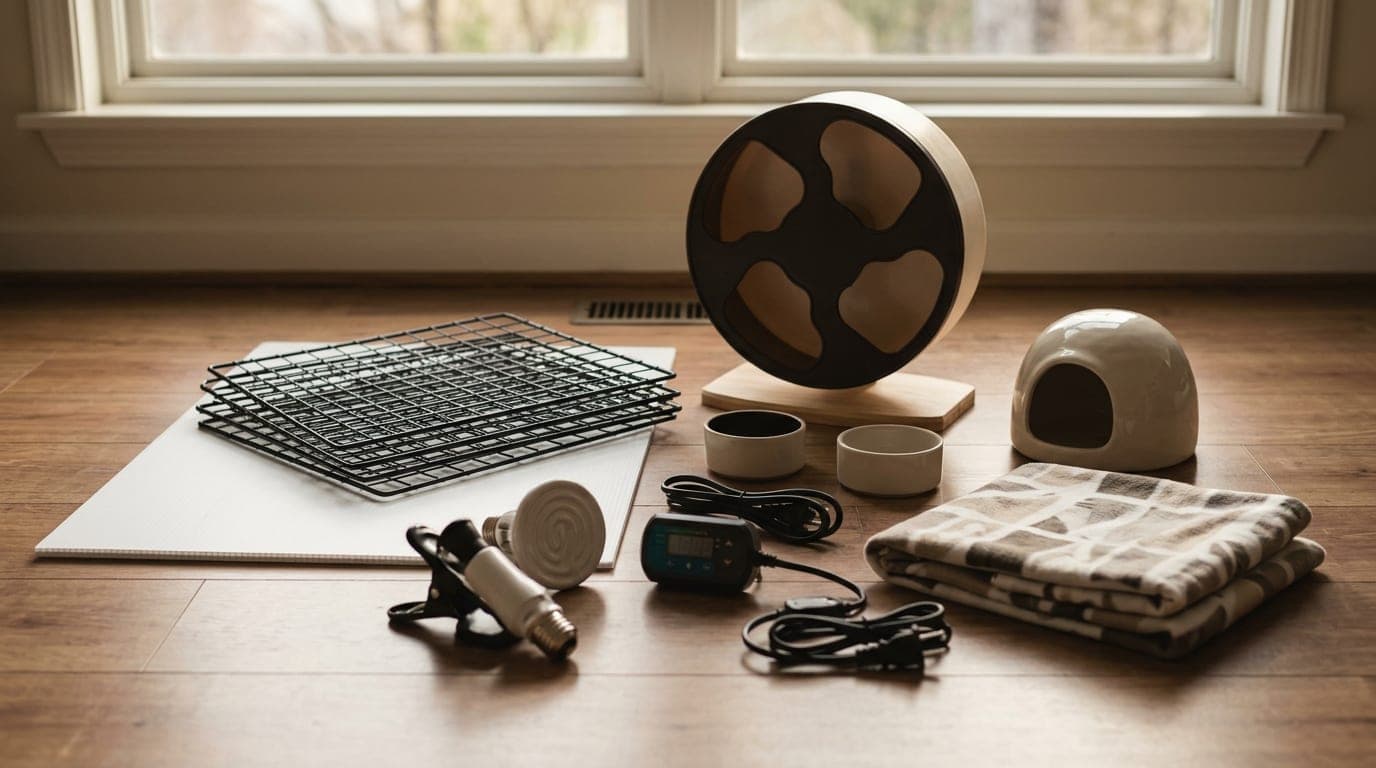
Setup-night layout · everything before assembly
A hedgehog setup is something you build once. The shopping list is small, the assembly is a single afternoon, and the consequences of getting it wrong are paid over the animal's whole life. This guide is the workflow version of the pet hedgehog cage pillar. What to buy, in what order, with the assembly sequence that prevents the most common first-week mistakes.
Plan for two trips: one to gather the components, one to confirm everything works the day before the hedgehog arrives. Total project time is about 3 hours spread over two days. Total cost: $220–395.
The shopping list
Buy everything before the hedgehog arrives. Splitting trips means you'll be short something at the worst possible moment.
The non-negotiables (~$170–270)
Cage. 4+ sq ft floor space, single level. C&C grids + coroplast sheet ($60–120), or a Midwest Guinea Habitat ($100–150). See the pillar for the comparison.
Heat setup. Ceramic heat emitter bulb ($15–25), clamp lamp with ceramic socket ($15–25), thermostat controller ($35–50, Inkbird ITC-308 is the standard). The thermostat is what people skip and shouldn't.
Wheel. 12-inch silent runner. Carolina Storm Wheel ($45) or Bucket Wheel ($30). Both are solid surface, near-silent, easy to clean. Wire-rung wheels and wheels under 11 inches are unsafe. Skip.
Hide. Ceramic igloo or wooden hut. $10–25. Single small entrance, covered top. One per cage.
Food and water dishes. Small ceramic, heavy enough not to tip. $10–20 for both.
Substrate. Fleece liner ($15–25 for 3–4 cuts) or aspen shavings ($10–20 first bag). Most experienced owners settle on fleece. See hedgehog bedding for the full comparison.
Thermometer/hygrometer. $10–15. A separate thermometer (not relying on the thermostat probe alone) lets you verify the heat is doing what you think it is.
Kibble. $10–25 for the first bag. Adult cat kibble (grain-inclusive, 30%+ protein, ≤15% fat) is what most experienced owners use. See the diet pillar for label-reading.
Insects (first supply). $10–20. Freeze-dried mealworms work for week one; you can upgrade to dubia or BSF larvae once the hedgehog is settled.
The optionals (~$30–80). Fine to skip in month one
- Digging box. A small plastic container with shredded fleece or organic soil. $0–15 for the container; substrate is whatever you have on hand.
- Snuffle mat or foraging puzzle: $15–30. Enrichment that gets old fast; not worth buying twice.
- Second hide. $10–25. Some hedgehogs use two; many use one and ignore the other.
- Carrier. $15–25. Small soft-sided pet carrier with a fleece liner. Needed for vet trips, not for day one.
Day-by-day assembly sequence
The two days before the hedgehog arrives.
Day -2 (48 hours before): build the cage and run the heat
- Clear and prep the space. Pick the cage location. Somewhere quiet, draft-free, not in direct sunlight, not next to an AC vent. Floor or a sturdy low table both work. Allow ~3 sq ft of clearance around the cage for cleaning access.
- Assemble the cage. C&C grids take ~45 minutes the first time; Midwest assembles in 15. Place the coroplast/plastic floor inside.
- Mount the heat lamp. Position the clamp lamp so the bulb is 6–10 inches above the highest interior surface of the cage. Verify nothing flammable is within 12 inches of the bulb (the CHE runs hot enough to be a real fire risk if anything touches it).
- Connect the thermostat. Wall outlet → thermostat → clamp lamp. Place the thermostat probe inside the cage at the level the hedgehog will be. Set target temperature to 75°F.
- Turn it on. Walk away. Heat is now stabilizing.
Day -1 (24 hours before): verify and load
- Check temperatures. With a separate thermometer (not the thermostat probe), confirm the cage is holding 72–80°F across the day and overnight. If it's running cold, raise the thermostat set point and confirm again. If it's running hot, lower the bulb height or drop wattage.
- Place substrate. Fleece liner cut to size, or 1–2 inches of aspen shavings.
- Set up the interior. Wheel in one corner. Hide in another corner, opposite the wheel. Food and water dishes near the cage entrance (the side you'll access most).
- Pre-fill food and water so the hedgehog can eat the moment they're brave enough. A small handful of kibble, fresh water.
- Hang the thermometer/hygrometer where you can see it from outside the cage without disturbing the animal.
- Do a final walk-around. Anything chewable that shouldn't be reachable? Anything that can fall and hurt them? Any gaps a small animal could squeeze through? Fix before tomorrow.
Day 0 (hedgehog arrives)
- Transport home in the carrier with a fleece liner. Drive directly. No errands.
- Place them in the cage gently. Don't tip them out; let them walk out of the carrier on their own.
- Leave them alone for 4–6 hours. Don't try to handle, don't peek constantly, don't introduce them to family members. They need to acclimate.
- First feeding. Once they've explored the cage and used the hide, refresh food and water. Note what they eat in the first night.
- Weight check. If possible, weigh the carrier with the hedgehog in it before placing, and again the carrier alone, to get a starting weight. Otherwise, weigh on day 2 once they've settled.
First-week rule: leave them alone
The biggest mistake new owners make in week one isn't a setup error. It's over-handling. The hedgehog needs a week of low-stress acclimation before being handled regularly. Specifically:
- Day 0–2: No handling. Just food, water, observation from a distance.
- Day 3–5: Brief contact at a time of day they're already awake. Put a fleece-lined hand near the cage entrance for 30 seconds; let them sniff. End before they get stressed.
- Day 6–10: Short pickup sessions, 5–10 minutes, in a quiet room. Some hedgehogs will ball up the whole time. That's fine. Don't try to "make" them unball.
- Week 2 onward: Gradually extend handling sessions. Most hedgehogs are comfortable being handled by month two; some take three.
Patience now compounds over the animal's whole life. Owners who push handling in week one often end up with a hedgehog that stays defensive longer than necessary.
Common setup mistakes (in order of frequency)
The things we see go wrong, ranked by how often:
- Heat setup without a thermostat. Lamp runs constantly → overheats. Or owner manually toggles → temperature swings. Get a thermostat.
- Cage too small. Pet-store starter kits in the 2–3 sq ft range. Hedgehog paces, gains weight, develops stereotypic behaviors. Either start at 4+ sq ft or expand within a month.
- Wrong wheel. Wire-rung wheel → injured feet. Too-small wheel (under 11 in) → spinal stress. Carolina Storm or Bucket Wheel, 12+ inches.
- Open-top cage with cats or dogs in the house. Even cautious cats eventually investigate. Cover the cage or move it to a closed room. See hedgehogs and cats for the full setup.
- Cage in a drafty location. Hedgehogs are warm-climate animals; even small drafts from a window or vent are stressful. Move the cage.
- Substrate everywhere except the right thing. Cedar shavings → toxic. Wire bottom → trapped feet. Cat litter → ingested. Fleece, aspen, or paper-based bedding only.
Cost-saving tactics that actually work
If the $220–395 budget is a stretch, here are the legitimate ways to bring it down without compromising the animal's welfare:
- Build a C&C cage instead of buying Midwest. $60 vs $130. Same end result, 30 minutes more work.
- Buy fleece liners as fabric off the shelf and cut them yourself. $10 for 4 cuts instead of $25 pre-made.
- Use a regular kitchen scale for weighing. $15 for a digital gram scale; many homes already have one.
- Skip enrichment for month one. Add toys and puzzles once the hedgehog is settled and you know what they like. Saves $30–50 upfront.
- Buy kibble in the 7-pound bag instead of small bags. Per-pound cost drops by 30%; a hedgehog eats slowly enough that the bag won't go stale.
What doesn't work as a cost-saver: skipping the thermostat ($35), buying a smaller cage ($30 saved → bigger problems later), or substituting hardware-store work lights for the proper clamp lamp with ceramic socket (fire risk).
The cage is the one thing in your house that runs 24/7 from now until the hedgehog dies. It's worth building right.
Common questions
Common questions
How long before the hedgehog arrives should I set up the cage?
At least 24 hours, preferably 48. The heat setup needs that long to stabilize and prove out — you want to confirm with a thermometer that the cage holds 72–80°F overnight before any animal is in it. The cage being 'set up' includes 'set up and verified to work.'
What if I'm on a tight budget?
You can skip the digging box, the extra hide, the snuffle mat, and other enrichment additions for the first month — total around $50 saved. You cannot skip the cage size, the heat setup, or the wheel. Those three are non-negotiable, full stop. Better to wait two weeks to save up than to start with an inadequate version of any of them.
Can I buy a pet-store starter kit and add to it?
Usually not worth it. The cages in starter kits are typically 2–3 square feet (under-sized for an adult), and the included wheels and substrates often need replacing. By the time you've upgraded the parts that matter, you've spent more than you would have building right the first time.
What if my hedgehog is small / a baby?
Same setup. Baby hedgehogs (6–8 weeks at adoption) grow into the adult cage size by 3–4 months. There's no smaller version of the cage that works — they need the full floor space within weeks. Buy once.
What's the single biggest setup mistake?
Underestimating heat. A 'warm' room in winter at 65°F is hibernation territory for an African pygmy hedgehog, and hibernation attempts in captivity often kill them. Heat lamp + ceramic heat emitter + thermostat is the standard setup — and the thermostat is the part most beginners skip.
Related on this site
Sources
Sources
- Hedgehog housing and environment — cage, substrate, enrichment — VCA Animal Hospitals
- African pygmy hedgehog — recommended captive husbandry — LafeberVet