
Housing & Cage Setup · 9 min read
Hedgehog Heat Lamp: The Setup That Prevents Hibernation Deaths
Ceramic heat emitter, wattage, mounting, thermostat — the heat setup most beginners get wrong, and how to build the one that actually works.
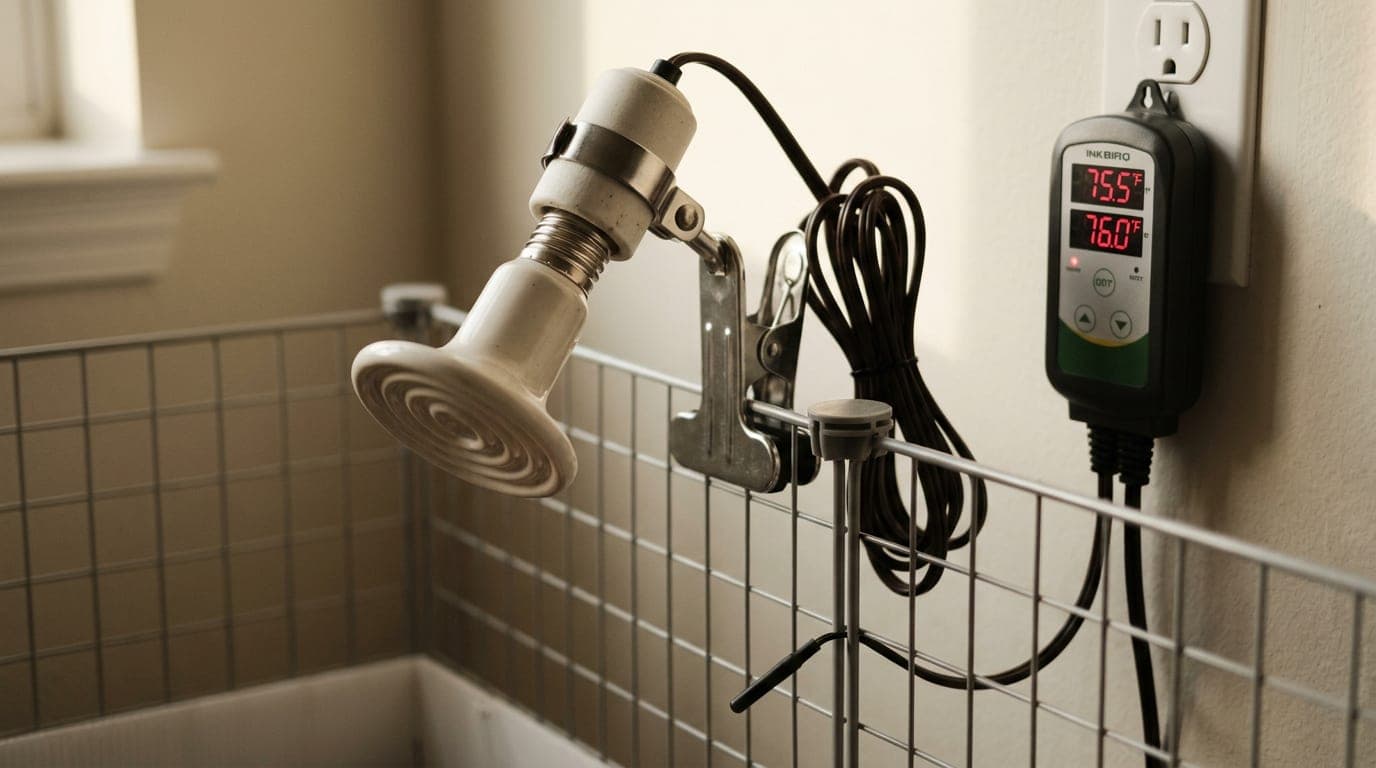
CHE bulb · clamp lamp with ceramic socket · thermostat controller · the only safe setup
This is the section that prevents the most preventable hedgehog deaths. African pygmy hedgehogs evolved in sub-Saharan grasslands at constant warm temperatures, and a captive one needs 72–80°F ambient temperature year-round. Below 70°F, they may attempt to hibernate. Hibernation in captivity often kills them, because their bodies aren't fat-loaded for it the way a wild European hedgehog's would be, and because the wake-up cycle relies on environmental cues a captive cage can't provide reliably.
The setup that prevents this is straightforward and costs $65–100 in parts. The mistake most beginners make is skipping the thermostat. We'll cover why the thermostat is the non-negotiable component, plus everything else about getting heat right.
The setup, named parts
Three components, in this order:
- Ceramic heat emitter (CHE) bulb. $15–25. A bulb that emits heat but no visible light. 60W for most cages, 100W for larger or colder.
- Clamp lamp with a ceramic socket. $15–25. A reflector-style work lamp with a porcelain (not plastic) socket. Plastic sockets melt at CHE operating temperatures.
- Thermostat controller. $35–50. Plugs into the wall outlet; the lamp plugs into the thermostat. The probe goes inside the cage. When cage temperature drops below set point → lamp on. Above set point → lamp off.
Total: $65–100. Wired in series: wall → thermostat → clamp lamp → CHE bulb.
That's the setup. Everything else in this guide is either explaining why each piece matters, troubleshooting when it isn't working, or naming specific brands.
Why a CHE specifically (not a regular bulb)
A ceramic heat emitter is a bulb-shaped device that converts almost all of its electrical input into infrared heat. No visible light, no UV. Three reasons that matters:
No light disruption. Hedgehogs are nocturnal. A visible-light bulb running 24/7 disrupts their sleep cycle, can cause stress over time, and reduces wheel use. Even "moonlight" or red nocturnal bulbs shift circadian patterns. A CHE solves this completely. Heat without light.
Heat-only output. Incandescent bulbs put out heat as a byproduct of producing light. CHEs are designed for heat. A 60W CHE puts out meaningfully more usable heat than a 60W incandescent in the same setup.
Long life. A quality CHE lasts 10,000+ hours. Over a year of continuous use. Incandescent bulbs run hotter at the filament and burn out faster.
The two brands most experienced owners use are Fluker's and Zoo Med. Avoid no-name CHE bulbs from generic marketplaces. The failure rate on cheap CHEs is unusually high, and a failed CHE in the middle of a cold night is what kills hedgehogs.
Why the clamp lamp needs a ceramic socket
CHEs run hot. The base of the bulb reaches temperatures that will soften and eventually melt a plastic bulb socket. A melted plastic socket is a fire risk and an electrocution risk.
The standard solution is a clamp lamp with a porcelain socket. Sold at most hardware stores as "ceramic socket work lights" or "reptile dome lamps." Cost: $15–25. They come with a built-in clamp that grips the cage edge, a reflector to focus heat downward, and a porcelain socket that handles CHE temperatures indefinitely.
A few specifics that matter:
- Wattage rating. The fixture's rated wattage must equal or exceed the bulb wattage. A clamp lamp rated for 60W with a 100W CHE in it will overheat. Match or oversize the fixture.
- Clamp vs. dome. Clamp lamps (with a c-clamp grip) are flexible. You can adjust the height by repositioning. Dome lamps (mounted to a screen lid) work for vivarium-style setups but are less common for C&C cages.
- Cord length. Make sure the cord reaches your thermostat outlet without straining. Extension cords add failure points; avoid.
Why the thermostat is non-negotiable
This is the part beginners skip and shouldn't. A heat lamp without temperature control is one of three things at any given moment:
- Not enough. Bulb is undersized, lamp runs constantly, cage never reaches 72°F. Hedgehog cold.
- Just right. Bulb is correctly sized for the room temperature right now. As soon as the room shifts (winter night, summer afternoon), it stops being right.
- Too much. Bulb is oversized, lamp runs constantly, cage exceeds 85°F. Hedgehog overheats.
A thermostat solves all three by turning the lamp on and off based on actual cage temperature. With a thermostat, an oversized bulb is safe (it just cycles off more often) and an undersized bulb is recognizable (the lamp runs constantly and never reaches set point. Clear signal you need a larger CHE).
The Inkbird ITC-308 is the standard recommendation. ~$35–50. Two-stage (can also control a cooling device if you have one), digital display, settable hysteresis (the dead-zone around the target temperature). Avoid:
- Dimmer-style thermostats. These reduce the lamp's voltage instead of cycling it on/off. They shorten CHE bulb life dramatically (we've seen CHEs fail in 3 months on a dimmer that should have lasted 18).
- Mechanical (dial-only) thermostats. Imprecise. Acceptable as a backup but not the primary control.
- Built-in "lamp timers." A timer turns the lamp on/off on a schedule, not based on temperature. Not the same thing.
Set the thermostat to 75°F as a starting target. Confirm with a separate thermometer that the cage holds 72–80°F across day and night before any animal is in there.
Sizing the bulb to your space
Wattage selection is dependent on three variables: cage size, room temperature, and enclosure type (open vs. covered).
| Cage size | Room baseline | Wattage |
|---|---|---|
| 4 sq ft | 70°F+ | 60W |
| 4 sq ft | 60–70°F | 60–100W |
| 6 sq ft | 70°F+ | 60–100W |
| 6+ sq ft | 60–70°F | 100W |
| Closed enclosure | Any | 60W (closed spaces hold heat) |
| Very cold space (under 60°F) | . | 100W + room heat |
Start with 60W for any standard C&C cage in a normal room. Run for 24 hours with the thermostat set to 75°F. Check across multiple times of day including the coldest overnight reading.
- If the cage holds 72–80°F consistently: you're set. 60W was right.
- If the cage never reaches 72°F, even with the lamp running constantly: you need more heat. Upgrade to 100W.
- If the cage exceeds 80°F regularly and the lamp is rarely on: you're over-sized. This is safer than under-sized (the thermostat will cycle correctly), but you can drop to a lower-wattage CHE on the next replacement.
Mounting and clearances
Hang the clamp lamp so the bulb is 6–10 inches from the highest interior surface the hedgehog can reach. Most setups land at 8–9 inches.
Closer than 6 inches: burn risk if the hedgehog climbs the cage walls and contacts the bulb. They will try this; you can't rely on them not to.
Further than 10 inches: the bulb's effective heat output drops off with distance (inverse square law). At 14+ inches, even a 100W CHE struggles to maintain cage temperature in a cold room.
The clamp should grip a sturdy edge. A C&C grid bar, a custom shelf, or the edge of a Midwest Guinea Habitat's frame. Tighten the clamp until it doesn't shift; gently push the lamp from a few angles to test. A lamp that falls into the cage is a fire risk and an injury risk.
Clearance from flammable materials: at least 12 inches in all directions. The CHE itself runs at ~400°F surface temperature. Fabric curtains, paper, untreated wood, plastic decor. All can ignite if in direct contact. The clamp lamp's reflector focuses heat downward; the sides and top of the bulb are also hot.
Where to put the thermostat probe
The probe is the part of the thermostat that measures temperature. The thermostat is only as accurate as where the probe is placed.
Place the probe inside the cage, suspended in clear air a few inches above the substrate, at roughly the height the hedgehog will spend most of their time. A small clip (the kind included with most thermostat kits) holds it to the side wall of the cage.
Don't place the probe:
- Directly under the lamp (reads hot, cycles off too early, rest of the cage stays cold)
- Pressed against metal grids (poor reading, mixes ambient air with conduction from the metal)
- Inside the hide (reads warm because the hedgehog's body heat accumulates there; gives a false high reading)
- Outside the cage (defeats the purpose entirely)
Verify with a separate thermometer/hygrometer hung in a different spot in the cage. The two readings should agree within 2°F. If they disagree by more, one of the sensors is off or the cage has uneven heating that needs addressing.
Common heat-setup mistakes
The patterns that come up repeatedly in panicked-new-owner messages:
The cage is too cold but the lamp is on. Bulb is undersized for the cage. Upgrade to higher wattage.
The cage is too hot and the lamp is rarely on. Bulb is oversized; thermostat is cycling correctly. Safe, just inefficient. Replace with a smaller CHE at next bulb replacement.
The cage temperature swings widely. Thermostat hysteresis (the dead zone) is set too wide, or the probe is in a bad spot. Tighten hysteresis to 1–2°F; reposition the probe.
The lamp keeps tripping the circuit breaker. Either a too-high-wattage bulb in a low-amperage circuit, or the clamp lamp's wattage rating is exceeded. Check the fixture's max wattage; consider a dedicated outlet.
The CHE failed unexpectedly. Most likely a cheap no-name bulb, a dimmer-controlled setup, or a bulb that took a sudden physical shock. Replace, but also recheck the underlying setup. Quality CHEs from Fluker's or Zoo Med, on a digital cycling thermostat, with a stable mount, last 12–18 months minimum.
The hedgehog is balling up tightly even with the heat on. Could be cold (verify cage temperature, not thermostat reading), could be sick, could be normal defensive behavior. If it persists for more than a day, see the health hub for next steps.
What to skip. Bad heating setups
- Heating pads under the cage as the primary heat source. They create hot spots, don't warm ambient air, and most pet-grade heating pads can't run safely for 24/7 use.
- Microwave heat disks (Snuggle Safe) as the only heat. Fine as an emergency backup; not adequate as the primary source. They lose heat over 6–8 hours and a cold hedgehog at 4am can't wait for you to microwave a new one.
- Space heaters pointed at the cage. Inconsistent, dries the air, and a fire risk if the heater tips. Acceptable as a secondary heat source for the room, not the cage.
- Incandescent "basking bulbs." Visible light disrupts the day/night cycle. Use a CHE.
- Black-light or "moonlight" bulbs. Still produce some visible light, still disrupt circadian patterns. Use a CHE.
When the heat does fail. What to do
CHE bulbs do eventually fail, usually after 12+ months. Power outages happen. Thermostats can break. Have a plan for when, not if:
- Check temperature first thing every morning. Catches failures before they become emergencies.
- Keep a backup CHE bulb on hand. $15–25. Better to have one and not need it than the reverse.
- Snuggle Safe disk for emergency supplemental heat. Microwave per instructions, place under (not in) the hide. Buys you 6–8 hours.
- Know your nearest exotic-animal vet's emergency hours. A hedgehog showing hibernation-attempt symptoms (cold to the touch, sluggish, won't unball) is a vet emergency.
The heat lamp setup is the single most important husbandry decision in a hedgehog's life. Worth getting right.
Common questions
Common questions
What wattage CHE do I need?
60W is appropriate for most cages (4–8 sq ft) in a room that holds 65–72°F. 100W for larger cages, colder rooms, or enclosed enclosures. 150W only for very large custom enclosures or unusually cold spaces. Don't guess — start with 60W, run for 24 hours with a thermostat, and increase if the cage doesn't hold 72–80°F overnight.
Can I use a regular heat lamp bulb instead of a CHE?
No. Visible-light bulbs (red, blue, white incandescents) disrupt the hedgehog's day/night cycle. CHE bulbs emit heat without visible light. The brief temptation to use a red 'nocturnal' bulb is worth resisting — even red light shifts circadian patterns over time.
Do I really need a thermostat?
Yes. Without a thermostat, the CHE runs constantly — which either overheats the cage (90°F+ in summer) or doesn't heat it enough (if the bulb is undersized and never cycles off). The thermostat turns the lamp on when the cage drops below your target, off when it exceeds it. The Inkbird ITC-308 ($35–50) is the standard. Skip the dimmer-style thermostats — they reduce bulb life and don't cycle cleanly.
Where exactly do I put the thermostat probe?
Inside the cage, at the level the hedgehog will spend most of their time — usually clipped to the side wall a few inches above the substrate. Not directly under the lamp (it'll read hot and cycle off too early). Not against the metal grid (poor reading). A few inches of clear air around the probe gives the most accurate reading.
How far above the cage should the bulb hang?
6–10 inches from the highest interior surface the hedgehog can reach. Closer than 6 inches risks burns if they climb. Further than 10 inches reduces effective heat. Most clamp-lamp setups end up at 8–9 inches, which is the sweet spot.
What if the heat lamp fails overnight?
Have a backup plan. A Snuggle Safe disk (microwaved before bed) under a hide gives 6–8 hours of supplemental heat in an emergency. A space heater in the room is a fallback. The real protection is checking the temperature first thing every morning — if you wake up to a cold cage, you know within hours, not days.
Related on this site
Sources
Sources
- Hedgehogs — environmental temperature requirements and hibernation risk — Merck Veterinary Manual
- Hedgehog housing and environment — heating, lighting, humidity — VCA Animal Hospitals