
Hedgehogs 101 · 11 min read
Hedgehog Care: The Honest Owner's Guide
What hedgehog care actually takes: heat, cage, diet, handling, vet. Written by owners, for owners. The realistic version pet stores won't tell you.
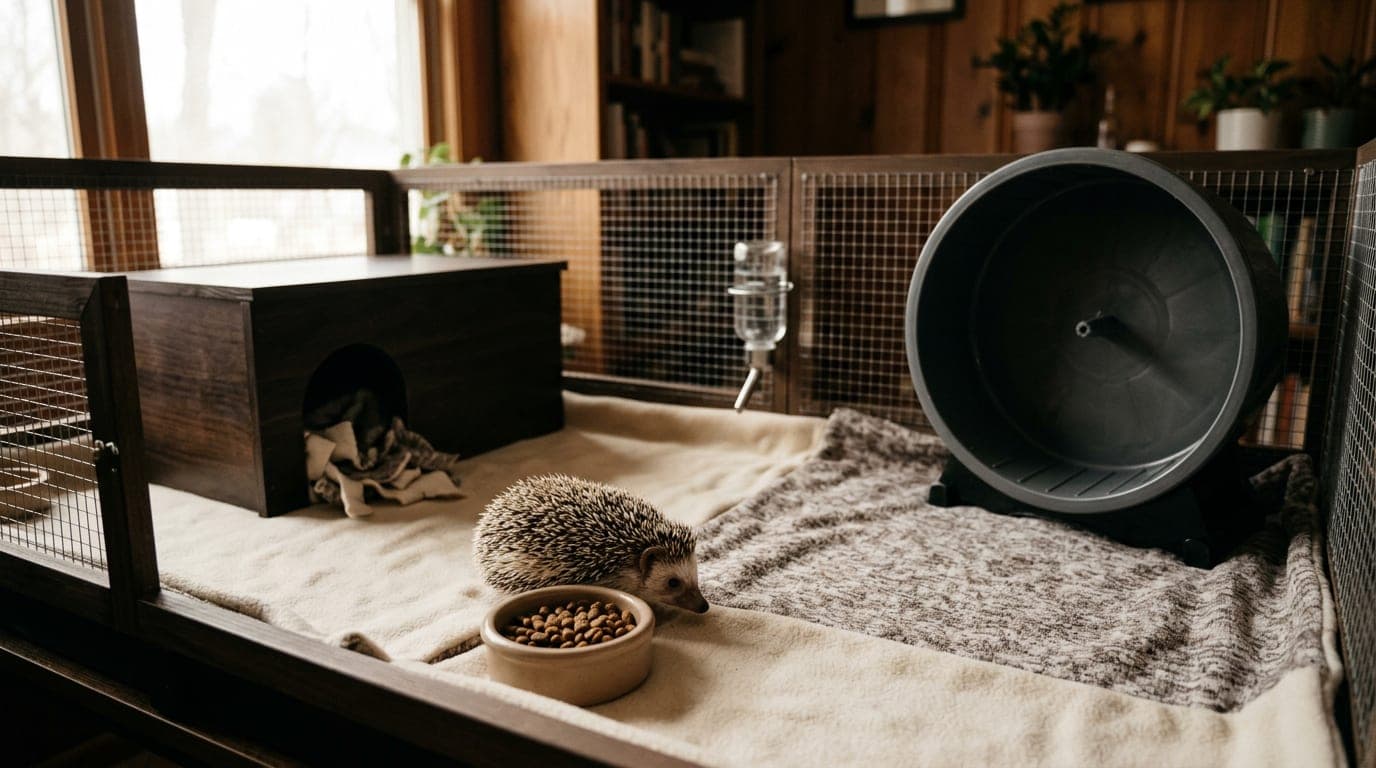
The care environment · cage, heat, food, wheel · the daily reality
Hedgehog care comes down to five things you cannot get wrong: a 72 to 80°F room year-round, an 8-square-foot cage, high-protein cat kibble (not the hedgehog food at the pet store), a 12-inch solid running wheel, and patient daily handling for the first month. Budget the first year at $700 to $1,200. They're nocturnal, often anti-social at first, occasionally smelly, and require an exotic vet most general practices can't competently see. The owners who love them tend to be people who enjoy quietly observing an animal do its thing.
That's the short version. The long version is worth reading because the gap between "minimum viable hedgehog care" and "actually thriving" is wider than most pet sites admit.
What "African pygmy hedgehog care" actually means
Almost every pet hedgehog in North America is an African pygmy (Atelerix albiventris), so this is African pygmy hedgehog care, full stop. The species detail isn't trivia. It's the reason the rules below are strict. African pygmies evolved in equatorial Africa and never developed safe hibernation. The European hedgehog of garden and storybook fame is a different animal that hibernates through winter, and care advice written for one is dangerous for the other. The single defining fact of African pygmy hedgehog care is that they need a constant 72 to 80°F and cannot ride out a cold snap the way a wild hedgehog can. Everything else, the cage, the diet, the wheel, the handling, sits underneath that one fact.
The five non-negotiables
These are the things you have to get right. Everything else is optimization.
1. Temperature: 72 to 80°F, year-round, no exceptions
This is the single most important thing about hedgehog care, and it's the one most new owners get wrong. African pygmy hedgehogs evolved in equatorial Africa. They didn't evolve to hibernate. When the room temperature drops below about 70°F, a captive hedgehog tries to enter a hibernation state that their body isn't actually equipped to complete safely. Failed hibernation attempts kill more captive hedgehogs than almost any single illness.
The practical implications:
- A "warm room" in your house is not warm enough. A standard 68 to 72°F room is in the danger zone.
- You will need a supplemental heat source — almost always a ceramic heat emitter (CHE) on a thermostat. Heat lamps work too if you can manage the day-night light cycle separately.
- You need a digital thermometer in the cage, not next to it. Cage temperatures can run 5°F lower than ambient room temperature.
- Air conditioning in summer can also push the cage too cold. The 72 to 80°F rule applies year-round, including August.
If you can't commit to maintaining this temperature 365 days a year, including when you travel, this isn't the right pet. We mean that literally. A hedgehog in a 65°F house for a long weekend can be dead by the time you get home.
The full heat-lamp guide walks through specific equipment and thermostat setups.
2. Cage: 8+ square feet of usable floor space
The pet-store starter cage is too small. Almost every starter cage marketed for hedgehogs is too small. The minimum that experienced owners agree on is 8 square feet of floor space, which works out to roughly a 4-foot by 2-foot footprint. More is better.
What the 8 square feet rule ignores: vertical levels don't count. Hedgehogs are not climbers. A multi-level cage with shelves looks larger but the usable hedgehog territory is just the floor.
The practical options most experienced owners settle on:
- A C&C (cubes and coroplast) cage at 2x4 grids or larger
- A large plastic storage bin (the 105-quart Sterilite or similar) with the lid removed and a custom mesh top
- A purpose-built guinea pig cage of adequate size (Midwest Wabbitat, Critter Nation single)
What you should not buy:
- Any cage marketed as a "starter" or "kit" hedgehog cage at most pet stores. Almost all are 4 to 6 square feet, which is too small.
- Any aquarium tank. Glass walls don't ventilate, the bottom heats unevenly, and the dimensions are wrong.
- Any wire-bottom cage. Hedgehog feet are not designed for wire grids.
The complete cage and setup checklist covers specific products and how to assemble them.
3. Diet: cat kibble first, insects second, treats third
The pet-store hedgehog food sold next to the hedgehogs at most stores is almost always a worse product than the cat food two aisles over. We've watched dozens of new owners overfeed mealworms and underfeed quality protein, and the long-term consequences are real: obesity, dental wear in the wrong places, and outright pickiness that makes future diet changes harder.
The 70/20/10 ratio that works:
- 70% adult cat kibble. Look for 30%+ crude protein, 10–15% fat, named meat (chicken, turkey, lamb) as the first ingredient. Skip kitten food (too fat), senior cat food (too low protein), and grain-free formulas (legume substitutes have raised concerns in cats and dogs).
- 20% insects. Mealworms in moderation (3 worms, twice a week max, since they're addictive and fattening). Crickets, dubia roaches, and black soldier fly larvae are better staples. Live or freeze-dried both work.
- 10% everything else. Pea-sized portions of fruit, vegetable, or cooked egg. Once or twice a week per food type.
What never goes in the cage: avocado (toxic), grapes and raisins (suspected toxicity), onion family (RBC damage), citrus (too acidic), chocolate (theobromine), dairy (lactose intolerance), raw meat (bacterial risk), anything wild-caught.
The full diet guide covers everything in depth, and the A–Z food reference answers most "can hedgehogs eat X" questions.
4. Wheel: 12-inch solid running surface, every night
A captive hedgehog without a wheel is a hedgehog that develops weight and behavioral problems within months. They evolved to cover several miles a night foraging in the wild. In a cage they can cover that distance only if you give them a wheel they can actually run on.
The non-negotiables:
- At least 12 inches in diameter. Smaller wheels force the back to arch in a way that damages the spine over months.
- Solid running surface. No wire, no slats, no spokes that toes can catch in. Carolina Storm Wheels and Silent Spinners are the two most-recommended brands among experienced owners.
- Mounted on a stand, not the side of the cage. Side-mounted wheels wobble and most hedgehogs won't use them consistently.
They will run on it. They will poop on it (this is unavoidable; they evolved to defecate while moving). You will clean it almost every night. This is part of the deal.
5. Handling: 20–30 minutes a day, every day, for the first month
Hedgehogs are not naturally social animals. They don't bond the way a cat or dog does. What you can do is gradually accustom them to your scent and your hand so that handling them becomes calm rather than terrifying for them.
The first month is the hardest:
- Daily handling, even when they huff and ball up. Especially when they huff and ball up.
- Always handle in the evening, when they're naturally awake. A hedgehog yanked out of a daytime sleep is a stressed hedgehog.
- Sit with them on your lap on a soft cloth. Don't try to play. Don't startle them. Let them unfurl when they're ready.
- After a few weeks, most hedgehogs stop balling up at every approach. Some never fully relax. That's individual variation.
If you skip the daily handling for the first month, you will end up with a hedgehog that stays defensive forever. The window for socialization is narrow and it doesn't reopen.
The hedgehog care routine, once setup is done
Past the first month, day-to-day hedgehog care is light. The work is front-loaded into getting the environment right. The ongoing rhythm is mostly maintenance and watching closely for changes.
| Cadence | What you actually do |
|---|---|
| Every day | Refresh food and water in the evening. Confirm the cage reads 72 to 80°F. Spot-clean visible poop. Handle for 20 to 30 minutes once they're awake and settled. |
| Every 1 to 2 days | Clean the wheel. They run on it and poop on it nightly, and a dirty wheel is the single biggest source of cage smell. |
| Weekly | Full bedding change if you use fleece liners (wash and swap). Wipe down dishes. Weigh the hedgehog on a kitchen scale and write the number down. |
| Every 2 to 4 weeks | Full cage clean. Check whether nails need trimming. Look over skin and quills while you handle. |
| Yearly | One wellness exam with an exotic vet even if nothing seems wrong. Hedgehogs past about 3 years benefit from twice a year. |
The weekly weigh-in is the highest-value habit on that list and the one most owners skip. A hedgehog losing weight is often the first and only early sign of a problem you can still treat cheaply. Thirty seconds with a kitchen scale and a notes app catches things a glance never will.
None of this is hard once the cage and heat are dialed in. That is the real shape of hedgehog care: a demanding setup, then a quiet routine, punctuated by paying close attention to an animal that hides illness well.
The first-year budget
Numbers vary by region but most owners we know land somewhere in this range for the first 12 months:
| Item | Range |
|---|---|
| Hedgehog (reputable breeder) | $200–400 |
| Cage and initial setup (wheel, hide, dishes, heat lamp, thermostat, bedding) | $250–400 |
| First vet visit and exam | $100–200 |
| Year-1 food, bedding, consumables | $150–300 |
| Total | $700–1,200 |
Years 2 and beyond, expect $400–600 per year if no major health issues come up. A single Wobbly Hedgehog Syndrome workup can run $500–1,000 on its own; budget another $300–500 a year as a soft buffer for unexpected vet costs.
The cheapest way to do this badly is to buy a $50 starter kit at a chain pet store and skip the heat source. The cheapest way to do this well is to buy a C&C cage from a community DIY guide ($60–80) and a quality CHE setup ($50–70), and put the savings toward a better breeder and a real vet exam.
What the first week looks like
You bring a hedgehog home. The cage is already set up. The room is at 75°F. Now what?
Days 1 to 3, leave them alone. No handling, no playing, no removing them from the cage. Place a worn t-shirt of yours in their hide so they get used to your scent passively. Keep a normal daily light cycle. Refresh food and water once each evening, then leave.
Days 4 to 7, short low-pressure handling. 5 to 10 minutes in the evening, on your lap, on a soft cloth. Let them ball up if they want. Don't unroll them. Just sit. The goal is for them to feel safe enough to unfurl on their own. By day 7, most hedgehogs will have done so at least once.
Week 2 onward, daily 20 to 30 minute handling sessions. Always evening, always low-stress. They will start to recognize you by scent. They will stop huffing as much. They will not become a cuddly pet, but they will become a relaxed one.
If you see any of these in week 1, call an exotic vet:
- Refusing food for more than 24 hours
- Cold body when you touch them (failed hibernation attempt; warm them gently against your skin and call immediately)
- Visible weight loss or sunken sides
- Discharge from eyes or nose
- Wheezing, clicking, or any abnormal breathing
- Inability to walk normally on all four feet
What the first year teaches you
Beyond the first week, hedgehog care settles into a routine. The things that surprise new owners:
They smell, sometimes. A clean cage with a healthy hedgehog has a faint earthy smell. A cage that hasn't been spot-cleaned in three days smells distinctly of hedgehog. The wheel is the worst offender — clean it every night and the smell stays manageable.
They're loud at 2am. Wheel running, food crunching, and water-bottle clicking is a nighttime soundtrack. Most owners eventually move the cage out of the bedroom.
They huff for life. Even bonded hedgehogs huff when startled. It's a defense reflex, not a sign that they hate you.
They self-anoint. This is the moment most new owners panic. The hedgehog encounters a new smell, foams at the mouth, and twists their body around to spread the foam onto their quills. Looks like a seizure. Is completely normal. The full explanation is in the behavior guide.
They get attached to one person. Or sometimes none. Some hedgehogs warm up to one human and remain wary of all others. Some never bond with anyone. Genetics and the first month of handling matter more than anything you can do later.
When to call an exotic vet
Most general-practice vets see fewer than five hedgehogs a year and aren't equipped to treat exotics safely. Find an exotic vet before you need one. The vet you call at 2am on a Sunday is the vet whose card you got in week one when nothing was wrong.
Schedule a vet visit if you see:
- Refusing food for 24+ hours
- Significant weight loss (over 10% in a month)
- Lethargy, weakness, or trouble walking
- Discharge from eyes, nose, or rear
- Diarrhea lasting more than 24 hours
- Skin issues like bald patches, scabbing, or excessive scratching
- Any symptom that wasn't there yesterday and is there today
The exotic vet directory guide walks through how to find one in your area.
The honest version: who shouldn't get a hedgehog
Most of this site assumes you've already decided to get one or are leaning that way. We owe you an honest off-ramp.
A hedgehog is a bad fit if:
- Your house can't reliably stay 72 to 80°F year-round, including when you travel
- Your nearest exotic vet is more than an hour's drive
- You wanted a pet that greets you, plays with you, or visibly enjoys human interaction
- You're getting one for a child under about 12 (the daily handling is on the adult, not the kid)
- You're not budgeted for a $500–1,000 unexpected vet visit
- You sleep in the same room and are a light sleeper
- Hedgehogs are illegal in your state (check the state legality guide)
If those don't apply and you've read the "are hedgehogs nice pets" piece without changing your mind, you're probably the right kind of owner for one.
Ready to actually start
The order most experienced owners recommend:
- Verify your state's legality
- Pick a vet (yes, before you have the animal)
- Set up the cage, run the heat for 48 hours to confirm it holds 72 to 80°F
- Find a reputable breeder — not a pet store
- Bring the hedgehog home
- Leave them alone for 3 days
- Begin daily handling
The next thing to read is the full cage and setup checklist. It covers the specific products, the assembly order, and the things that aren't obvious until you've already bought the wrong version twice.
Common questions
Common questions
How much does it cost to take care of a hedgehog?
First-year budget runs $700–1,200 in most parts of North America. That breaks down to roughly $200–400 for the hedgehog itself from a reputable breeder, $250–400 for cage and initial setup (wheel, hide, dishes, heat lamp, bedding), $100–200 for the first vet visit and exam, and $150–300 for the year's food, bedding, and consumables. After year one, ongoing costs run about $400–600 a year if there are no major health issues.
Are hedgehogs hard to take care of?
Moderately hard. The hardest parts are getting the heat right (most homes are too cold for them year-round), finding an exotic vet before you need one, and accepting that they're nocturnal so most of your interaction will be in the evening. The actual day-to-day care is straightforward once the setup is right.
How long do pet hedgehogs live?
Captive African pygmy hedgehogs typically live 3–5 years, with 6–8 years possible under excellent care. The biggest factors that shorten lifespan are inadequate heat (which causes failed hibernation attempts), the wrong diet (mealworm-heavy or low-protein kibble), and delayed vet care for treatable conditions like dental disease or wobbly hedgehog syndrome.
What do hedgehogs eat besides kibble?
Insects (mealworms, crickets, dubia roaches) two to four times a week, and small amounts of fruit, vegetable, or cooked egg as occasional treats. The 70/20/10 ratio works for most owners: 70% high-protein cat kibble, 20% insects, 10% everything else combined. Skip avocado, grapes, citrus, onion family, chocolate, and anything dairy.
How often do you need to clean a hedgehog cage?
Spot-clean daily (remove visible poop, refresh water and food). Full clean weekly if you use fleece liners (wash and replace), every 1–2 weeks if you use loose substrate like aspen shavings (full replacement). Clean the wheel every 1–2 days, since they will run on it and poop on it most nights.
Is African pygmy hedgehog care different from other hedgehogs?
For pet owners, no. The hedgehog kept as a pet in North America is almost always an African pygmy (Atelerix albiventris) or a close hybrid, and everything on this page is written for that animal. 'Pygmy hedgehog,' 'African pygmy hedgehog,' and color names like albino, salt-and-pepper, or pinto all refer to the same species and the same care: same temperature range, same diet, same cage. Albino hedgehogs have no extra needs, though their eyes are slightly more light-sensitive, so keep the cage out of harsh direct light. European hedgehogs are a different species, are not legal pets in the US, and aren't covered here.
Related on this site
- Hedgehogs 101 — pillar guide
- Hedgehog setup checklist — the cage, the heat, the supplies
- What do hedgehogs eat — the full diet guide
- Hedgehog heat lamp — the most-fucked-up part of new setups
- Are hedgehogs nice pets — honest expectations before you commit
- Hedgehog vet near me — find an exotic vet before you need one
- Hedgehog behavior — what's normal, what's not
- Hedgehog species — which one is the pet, and which you legally can't own
Sources
Sources
- African pygmy hedgehog — basic information, husbandry, and clinical considerations — LafeberVet
- Hedgehogs — owning, housing, and general care — VCA Animal Hospitals