
Diet & Nutrition · 10 min read
What Insects Can Hedgehogs Eat? The Complete Feeder Insect Guide
Crickets, dubia roaches, and BSF larvae are the strong staples. Mealworms in moderation. Waxworms rarely. Skip wild-caught. The full ranking with reasons.
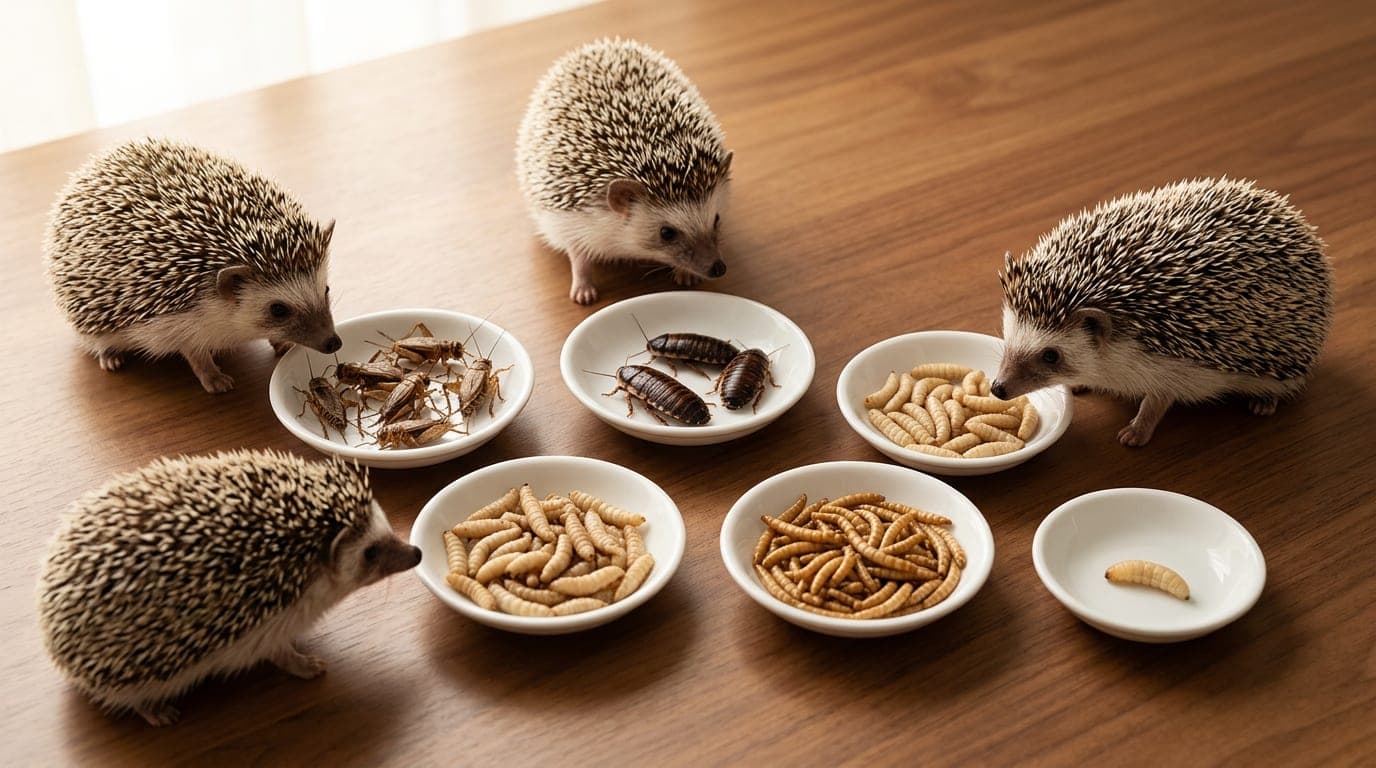
The insect rotation · staples, moderate, and treat-only
Insects make up about 20% of an ideal hedgehog diet. Inside that 20%, not all insects are equal. The strongest staples are crickets, dubia roaches, and black soldier fly larvae. Mealworms work in moderation. Waxworms are a once-a-month treat at most. Wild-caught anything is a parasite risk that's not worth taking. This guide ranks the common feeder insects by what experienced owners actually feed, why some are better than others, and how to think about live versus freeze-dried versus canned.
Why insects matter at all
Hedgehogs are insectivores. Even on a captive diet built around quality cat kibble, the 20% insect portion isn't optional. It provides three things kibble can't fully replicate:
- Chitin and chitin-derived fiber. The hard exoskeleton of insects breaks down in a hedgehog's gut into compounds that support healthy digestion in ways plant fiber doesn't.
- Specific amino acids and trace minerals. Insect tissue has a different amino acid profile than processed kibble protein. Variety here keeps the diet complete in ways the same kibble every day can't.
- Enrichment and natural behavior. Hunting a moving cricket triggers behaviors a hedgehog doesn't get from kibble in a bowl. Mental stimulation matters as much as nutrition.
Skipping insects entirely produces a hedgehog that's technically fed but missing a substantial part of what their gut and brain are built for. Owners who go years without insect feeding usually start seeing symptoms eventually: stool changes, behavioral flatness, sometimes weight issues that don't track to anything obvious.
The strong staples
These are the insects experienced owners reach for as the foundation of insect feeding.
Crickets
The most commonly fed staple in North America. House crickets (Acheta domesticus) and brown crickets (Gryllus assimilis) are the typical varieties.
Nutritional profile: Roughly 20% protein, 6% fat (live weight basis). Good calcium-to-phosphorus ratio when gut-loaded.
Practical:
- Live, freeze-dried, or canned all work
- Live crickets need their own care (escape risk, smell, noise) but offer the most enrichment
- Freeze-dried is the most owner-friendly: clean, stores well, no ongoing care
- Canned (ZooMed and similar brands) is convenient but loses some nutritional value vs live or freeze-dried
Portion: 2 to 3 crickets per session, 1 to 2 sessions per week.
Source: Pet stores, online feeder suppliers (Josh's Frogs, Rainbow Mealworms, ABDragons). Avoid bait shops — bait crickets are bred for fishing and may have different microbial profiles.
The full per-insect deep dive is on the crickets food entry.
Dubia roaches
The best-rated staple by most experienced owners but harder to source than crickets.
Nutritional profile: Roughly 23% protein, 7% fat. Best calcium-to-phosphorus ratio of common feeders.
Practical advantages:
- Don't climb glass (no escape problem)
- Don't bite
- Don't smell or make noise the way crickets do
- Live longer than crickets (a dubia colony is more sustainable than a cricket colony)
- Most hedgehogs accept them readily
Practical disadvantages:
- The squeamishness factor — they look like cockroaches because they are cockroaches
- Harder to find at chain pet stores; usually online order
- More expensive per insect than crickets
Portion: 2 to 4 dubia per session, 1 to 2 sessions per week.
Source: Almost exclusively online from specialty feeder suppliers. Worth the extra step for owners who keep multiple insectivores or want to stop dealing with crickets.
Black soldier fly larvae
Sold under various trade names: calci-worms, phoenix worms, NutriGrubs. All the same thing.
Nutritional profile: Roughly 17% protein, 14% fat (slightly higher fat than crickets/dubia). Notable for very high natural calcium content — some of the highest of any commonly-fed insect.
Practical:
- Easier than crickets; harder than mealworms
- Slow-moving, so easy for a hedgehog to catch when fed live
- Available freeze-dried and live
- The natural calcium content makes them especially valuable for hedgehogs at risk of calcium deficiency or for breeding females
Portion: 4 to 6 larvae per session, 1 to 2 sessions per week.
Source: Online feeder suppliers, some pet stores. Brand name varies but the species is the same.
A reasonable insect rotation for an adult hedgehog uses all three of these as the staples — crickets one night, dubia the next session, BSF larvae a third — varying what's offered to keep nutritional variety and behavioral interest.
The moderate options
These work but with limits.
Mealworms
The most-fed feeder insect by new owners and the most common cause of dietary problems. Mealworms aren't bad — they're fine in moderation. The issue is that they're easy to over-feed.
Nutritional profile: Roughly 18% protein, 13% fat. Lower calcium-to-phosphorus ratio than crickets or dubia.
Why limits matter:
- High palatability. Hedgehogs visibly prefer mealworms over almost anything else.
- The addiction pattern. A hedgehog fed mealworms several times a week will often refuse kibble in expectation of more.
- Higher fat content than the strong staples.
- Lower calcium-to-phosphorus ratio means relying on mealworms can contribute to long-term calcium issues.
Portion: 2 to 3 mealworms per session, twice a week max. Most experienced owners run mealworms as the rare-treat option rather than a regular staple.
Forms:
- Live mealworms are slightly higher quality nutritionally but require their own care
- Freeze-dried mealworms (most common) are convenient and accepted by almost any hedgehog
- Dried mealworms from the bird-feeding aisle are the cheapest and lowest quality — they're meant for songbirds, not pet insectivores
The full per-insect rules are on the mealworms food entry.
Hornworms (tomato hornworms / Manduca larvae)
Less common but worth knowing. Big, juicy, low-calcium, high-water-content larvae sometimes used for reptiles.
Nutritional profile: Roughly 9% protein, 3% fat, 85% water. The high water makes them more of a hydration treat than a protein source.
Portion: Small piece (or one whole small hornworm), once a month or less. Useful if a hedgehog is dehydrated; otherwise not part of regular rotation.
Source: Online feeder suppliers. Sometimes ordered specifically for sick or recovering hedgehogs.
The treat-only options
Use these like candy: rarely, with intention.
Waxworms
The most addictive feeder insect. The leading dietary cause of preventable obesity in pet hedgehogs.
Nutritional profile: Roughly 14% protein, 25% fat (live), or 56% fat dry-weight basis. Very low calcium relative to phosphorus.
The reason for the warning: waxworms are roughly three times the fat content of mealworms and four to five times that of crickets or dubia. Fed regularly, they cause weight gain that's hard to reverse, and they create a pickiness pattern where hedgehogs refuse normal food.
When they earn their keep:
- Masking bitter oral medication (the high palatability hides the taste)
- Encouraging a thin or recovering hedgehog to eat
- A rare special treat for an animal whose weight is stable
Portion: 1 waxworm, no more than 2. Twice a month maximum.
The full warning + recovery protocol if your hedgehog has gotten addicted is on the waxworms food entry.
Superworms (Zophobas morio)
Sometimes confused with mealworms; actually a different species and quite different nutritionally.
Nutritional profile: Roughly 19% protein, 18% fat. Larger than mealworms (3 to 5 cm), more chitin per insect.
Practical: Less commonly fed than mealworms because the larger size can be hard for some hedgehogs to handle, and the higher fat content puts them in the moderate-to-treat zone. Some experienced owners use them as occasional variety.
Portion: 1 superworm, once or twice a week max.
The avoid list
Insects not to feed, ever:
Wild-caught anything
This includes insects you find in your backyard, garage, or near outdoor lights. The risks:
- Parasites. Wild insects often carry parasitic worms or protozoa that captive-bred feeders are screened against.
- Pesticide exposure. Even insects from organic-looking yards may have crossed treated areas.
- Heavy metal accumulation. Insects in urban environments accumulate trace metals you can't see.
- Unknown species. Some wild beetles and bugs are mildly toxic to small mammals.
The risk-benefit math doesn't work. There's no nutritional benefit to wild insects over feeder-bred ones, and the downside can require expensive parasite or toxicity treatment.
Fireflies (lightning bugs)
Specifically dangerous. The chemical that makes them glow (lucibufagin) is toxic to many small animals. Fatal to hedgehogs in some documented cases. Never let your hedgehog access a yard where fireflies are present.
Centipedes, scorpions, and venomous insects
The bite or sting can injure a hedgehog significantly. Hedgehogs in the wild can handle some of these because of evolved resistance and behavior, but pet hedgehogs raised in captivity have neither the experience nor (sometimes) the resistance.
Anything you can't identify
If you don't know exactly what insect you're feeding, don't feed it. The cost of a few extra dollars on confirmed feeder insects is much less than the cost of one mistake.
Live versus freeze-dried versus canned
Each form has tradeoffs.
Live
Pros:
- Maximum nutritional value (gut-loaded, fresh)
- Best enrichment (triggers hunting behavior)
- Most engaging for the hedgehog
Cons:
- Requires its own setup (enclosure, food, water for the insects)
- Smell, noise, escape risk
- Costs add up if you can't keep colonies alive
- Squeamishness factor for the owner
When live makes sense: owners who keep multiple insectivores, owners who want maximum enrichment, owners who don't mind the insect husbandry.
Freeze-dried
Pros:
- Clean, easy, stores indefinitely
- No insect husbandry
- Most hedgehogs accept readily
- Available everywhere
Cons:
- Some nutritional loss vs live (variable depending on processing)
- More expensive per insect than live
- Less enrichment value (no movement to hunt)
When freeze-dried makes sense: most owners. This is the practical default that works for the majority of households.
Canned
Pros:
- Soft texture (good for older hedgehogs with worn teeth)
- Easy storage
- No insect husbandry
Cons:
- Lowest nutritional value of the three forms
- Open cans go off quickly (use within 5 days, refrigerated)
- Sometimes packed in liquid that hedgehogs don't take to immediately
When canned makes sense: specific situations like older hedgehogs, post-dental work, or as a backup when freeze-dried supplies run out.
Gut-loading basics
If you're feeding live insects, gut-loading dramatically improves their nutritional value. Gut-loading means feeding the insects nutrient-rich food for 24 to 48 hours before feeding them to your hedgehog. The insects' guts then deliver those nutrients to your animal.
Standard gut-load:
- High-quality grain (oat bran, wheat bran)
- Small amounts of carrot or sweet potato (for moisture)
- A pinch of calcium powder dusted on the food
- Fresh water in a water-gel cup
Commercial gut-load mixes (Repashy SuperLoad, Mazuri Better Bug Gutload) are formulated specifically for this purpose. They're worth the few dollars if you're keeping live insects.
For freeze-dried or canned, gut-loading isn't possible — the insects are already processed. The nutritional gap relative to gut-loaded live is one of the tradeoffs of going freeze-dried.
Insect feeding schedule
A reasonable rotation for an adult hedgehog:
- Monday: 3 crickets (live or freeze-dried)
- Wednesday: 4 to 6 BSF larvae or 3 dubia roaches
- Friday or Saturday: 2 to 3 mealworms (the once-a-week mealworm allowance) OR another cricket/dubia session if you're avoiding mealworm pickiness
Skip days are the rest of the week. Kibble + water is the daily staple.
Adjust for:
- Pregnant or lactating females: more frequent insect feeding (often daily during nursing) under vet guidance
- Growing juveniles (under 6 months): slightly more frequent insect feeding for the protein
- Sedentary or overweight adults: fewer insect sessions or smaller portions
- Active recovery from illness: vet-specified
Common mistakes
The patterns we see most often in new owners' insect feeding:
- Free-flowing mealworms. A bag of mealworms shouldn't last less than a month. If yours is going faster, you're feeding too many.
- Treating waxworms as a regular insect. They're a treat, not a staple. Never daily, never even weekly.
- Skipping insects entirely. Some owners are squeamish and feed only kibble. Long-term this produces a marginal diet even if the kibble is high quality.
- Wild-caught experimentation. Even one parasite event can mean weeks of vet treatment.
- Buying "insect treats" labeled for other species. Bird-aisle dried mealworms are usually lower quality than feeder-bred. Reptile-specific products may be calorie-dense in ways that don't suit hedgehogs.
- Live insects free in the cage overnight. Crickets in particular hide in cage crevices and ambush at 3am. Always feed live in a separate enclosed area.
The pattern across all of these: insects are a category that rewards intention. The owners who think about insect feeding (which species, what frequency, what form) end up with healthier hedgehogs than the owners who just dump a handful of mealworms in the dish every night.
When to talk to a vet about insect feeding
The threshold is lower than people think. Schedule a non-emergency conversation if:
- Your hedgehog refuses kibble after starting insect feeding
- They've gained or lost more than 10% body weight in a month
- Their stool changes consistently after a specific insect
- You're considering live insects and want guidance on suppliers and gut-loading
Most exotic vets will do a 15-minute phone consult on diet specifically. It's cheaper than a visit and almost always worth the time.
The full diet pillar covers the kibble side, the treat rotation, and the foods to avoid. Insects are 20% of the picture; this guide covers that 20%. The other 80% is structured equally carefully.
Common questions
Common questions
What insects are best for hedgehogs?
Crickets, dubia roaches, and black soldier fly larvae (sometimes sold as calci-worms or phoenix worms) are the three most-recommended staples. They have favorable protein, fat, and calcium-to-phosphorus ratios, and they're not addictive the way mealworms or waxworms can be. Live, freeze-dried, or canned all work; live is most enriching but more work.
Can hedgehogs eat live insects?
Yes, and many owners argue live is the best option for enrichment because it triggers natural hunting behavior. Drop a few live crickets or dubia roaches into a small enclosed area (a tub, the bathtub) and let your hedgehog hunt. Don't release live insects free in the main cage overnight — they hide and ambush. If live isn't practical, freeze-dried is the most owner-friendly alternative.
How many insects should a hedgehog eat per day?
Insects make up about 20% of a hedgehog's diet — roughly 2 to 4 sessions per week, with 3 to 5 insects per session depending on type. Daily insect feeding can lead to weight gain and pickiness, particularly with mealworms or waxworms. Most owners feed insects 2 to 3 times a week and leave the kibble as the daily staple.
Are wild-caught insects safe?
No. Wild-caught insects carry parasite and pesticide risks that captive-bred feeders don't have. The risk-benefit math is bad: there's no nutritional benefit to wild insects over feeder-bred ones, and the downside (parasitic infection, pesticide exposure) can require expensive treatment. Always buy from a feeder supplier, never from a bait shop or your backyard.
Why are mealworms only okay in moderation?
Two reasons. First, mealworms are higher in fat (around 18% by dry weight) and lower in protein than crickets or dubia roaches. Second, hedgehogs find them unusually palatable — many will start refusing kibble in expectation of more mealworms if fed daily. The 2-to-3-twice-a-week limit prevents both the dietary imbalance and the addiction pattern.
Related on this site
Sources
Sources
- African pygmy hedgehog — diet, insect feeders, and nutritional considerations — LafeberVet
- Hedgehogs — feeding, husbandry, and dietary management — VCA Animal Hospitals