
Supplies & Gear · 6 min read
What Do Hedgehogs Like to Play With? (Honest Answer + What Actually Works)
Hedgehogs don't play like cats or dogs — they forage, explore, self-anoint. What enrichment actually engages them, what they ignore, and the stuffed-dog-toy hack.
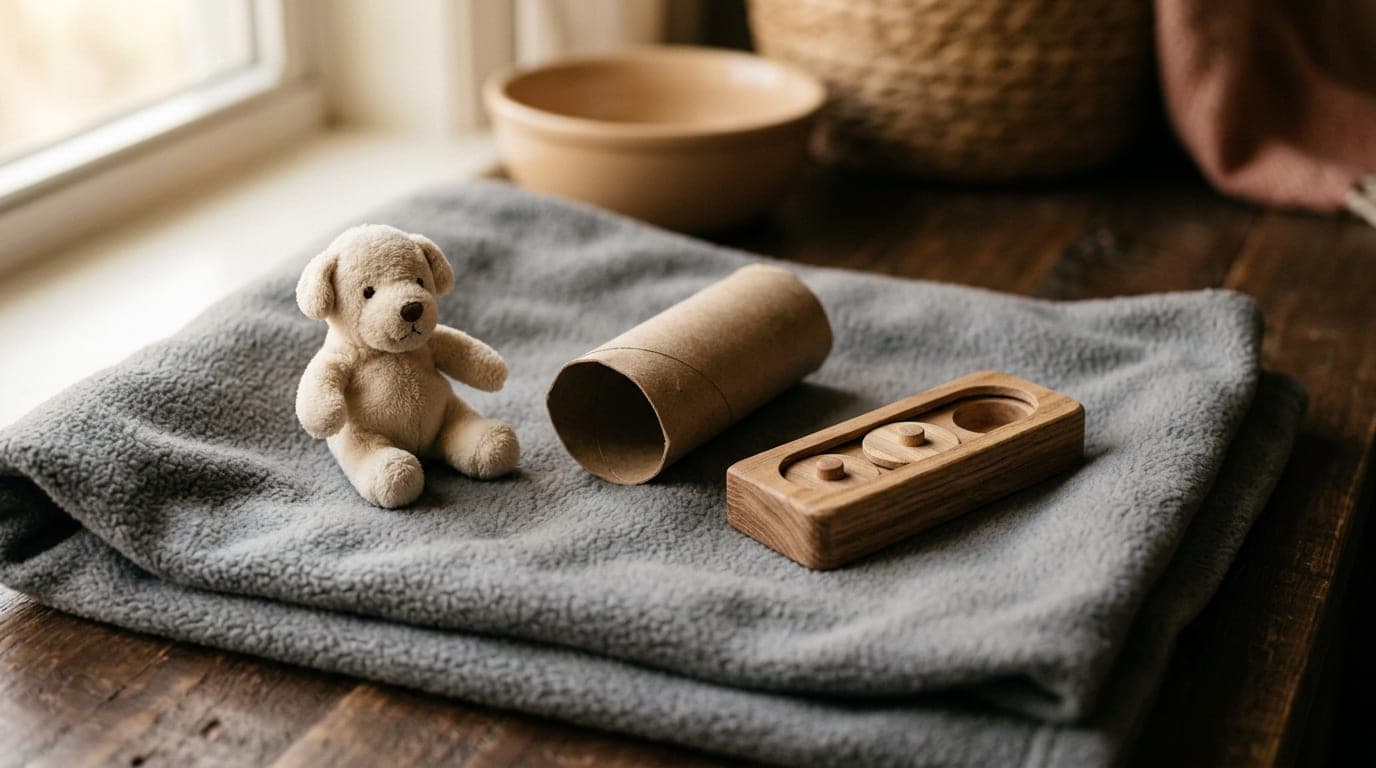
Simple enrichment · stuffed companion, toilet roll, foraging puzzle
Hedgehogs don't play with toys the way a dog plays fetch. They don't chase a string the way a cat does. The honest answer to "what do hedgehogs like to play with" is closer to "what do they like to explore, forage, dig in, and occasionally bump around the cage". Which is play, just by hedgehog standards.
The owners who enjoy this most are the ones who reframe their expectations: not "let's play with the hedgehog" but "let's give the hedgehog things to investigate." The investigation is the play.
What play actually looks like for a hedgehog
In the wild, an African pygmy spends most of their active hours doing four things: walking, sniffing, eating insects, and occasionally digging or climbing. Captive hedgehogs replicate this when given the chance. They'll wander a defined space, sniff everything, root in soft materials, and run on a wheel for hours.
What you won't see, no matter what you try:
- Chasing a thrown ball
- Engaging in mutual play with you or another animal
- "Tricks" or trained behaviors (a few hedgehogs learn to come to a sound, that's about it)
- Cuddling on demand
What you will see, with the right setup:
- Steady wheel running at night (the single most reliable activity)
- Exploring new objects placed in the cage
- "Self-anointing" when they encounter a new scent. Twisting weirdly to spread saliva on their quills
- Foraging for hidden food
- Occasional climbing on cage furniture (mostly bad. They fall)
The single best enrichment purchase: the wheel
If you only buy one thing for enrichment, buy a 12-inch silent runner wheel. We have a whole guide on picking one, but the short version: Carolina Storm Wheel or Bucket Wheel, ~$30–45, and your hedgehog will use it most nights for hours.
A captive hedgehog without a wheel:
- Gains weight (no calorie burn to balance the kibble intake)
- Develops stereotypic behaviors (pacing, repetitive movements)
- Becomes harder to handle (under-stimulated animals are stressed animals)
- Lives a shorter life on average
Everything else in this guide is supplementary. The wheel is foundational.
Toys and enrichment that actually work
The supplementary items that get genuine use:
Small stuffed dog toys (the cheap hack)
The "stuffed dog toy" hack is real. Many hedgehogs adopt a small stuffed dog toy: the kind sold for small-breed dogs. As a cage companion. They'll sleep curled against it, root underneath it, sometimes nudge it around the cage.
What to buy: A small (3–6 inch) stuffed plush toy with no detachable parts. The squeakers in dog toys are fine. Most hedgehogs don't squeak them, but it's not dangerous either.
Brands and types that work: Look in the small-dog or puppy section of any pet store. Plain plush bodies without ribbons, beads, or attached small parts. Generic small-breed plush toys work fine. No need for hedgehog-specific marketing.
What to verify: No small parts that can detach. No real "eyes" or "nose" buttons (sew them off if necessary). Hedgehogs chew sometimes; you want it failure-safe.
Don't expect every hedgehog to use it. Some adopt the toy immediately and sleep with it for years. Others ignore it. $5–15 is cheap enough that the experiment is worth it.
Toilet paper rolls
Free, surprisingly engaging. The catch: cut a slit lengthwise so the hedgehog can't get stuck inside.
A small or large hedgehog walking into an unmodified TP tube can wedge themselves and panic. The slit lets the cardboard flex if they push through. Cut it before offering, every time.
How they use it: roll it around, push their face into it, sometimes carry it across the cage. Replace when soiled.
Foraging puzzles
Anything that hides food and makes them work for it. Options:
- Commercial foraging mats ("snuffle mats". Sold for dogs at $15–30). Hide a few mealworms in the fleece strands; hedgehog roots them out. Available in various sizes.
- DIY foraging puzzles. Egg carton with kibble hidden in some cups, paper bag with treats inside, paper-towel-roll mazes. Free, replaceable.
- Loose fleece scraps in a small dish with insects hidden underneath. Cheapest "foraging" setup that works.
The trick: not every meal. If you forage-feed daily, it stops being enrichment and becomes just slow eating. Once or twice a week as a change-of-pace.
Digging boxes
A small plastic container (~6×6 inches and 3+ inches deep) with shredded fleece scraps or organic soil. Set it in the cage; let them dig.
What works: shredded fleece (cleanest), oat-based pet bedding (mildly interesting), organic potting soil with no fertilizer or pesticide (most natural). Avoid sand (gets in eyes), kitty litter (dust), and any scented additives.
Some hedgehogs dig regularly. Some ignore it. $5–10 for the container, free for the contents.
Hide objects (low huts and tunnels)
Small ceramic hides, fabric tunnels, even tipped-over shoe boxes. Hedgehogs are explorers. Anything new in the cage gets investigated. Rotate occasionally to keep it interesting.
What works: anything they can fit into, with at least one open end. Small-animal fabric tunnels ($10–20) are reliable. Wooden huts ($15–25) are durable.
What hedgehogs ignore (and what to skip)
Some "hedgehog toys" sold at pet stores get bought, used once, and stored forever:
- Hedgehog-shaped squeaky toys. Marketing, not enrichment. Hedgehogs don't chase squeaky things.
- Treat balls (the kind dogs roll to dispense kibble). Hedgehog limbs aren't built for rolling motion; the toy mostly sits there.
- Wooden chew sticks. Hedgehogs are insectivores, not rodents. They don't have the chewing instinct rabbits or guinea pigs have.
- Bird-cage swings or perches. Hedgehogs aren't built for them. Fall risk.
And actively harmful:
- Exercise balls. Feet slip through slits, can overheat, can't communicate distress. Don't.
- Leashes and harnesses. Hedgehogs don't walk on a leash. The harnesses don't fit the body shape correctly.
- Anything with small detachable parts. Choking risk.
- Yarn or string-based toys. Get tangled in feet and quills.
Out-of-cage enrichment
The other half of enrichment: time outside the cage.
A few times a week, set up a small enclosed area (a fleece-lined playpen, a small room with the doors closed, even a bathtub with a towel down) and let the hedgehog explore. 15–30 minutes is plenty.
What to include in the play area:
- A few hides (small boxes, fleece caves) so they can retreat
- One or two novel objects (different texture, different smell) for them to investigate
- A treat or two scattered to forage
- You sitting nearby, available if they approach but not forcing interaction
What to avoid:
- Large open spaces that look exciting to you but stress the hedgehog
- Other pets (cats, dogs) in the same room
- Children running around
- Hard surfaces with no escape options
- Anywhere they can squeeze under furniture and disappear
A note on training
Hedgehogs can be lightly conditioned but not really trained in the dog sense. A few things some owners successfully teach:
- Recognizing their name (or any consistent sound) when paired with a small treat. About 50% of hedgehogs learn this; the rest don't bother.
- Walking to the cage door when they want out. Sometimes happens incidentally over time.
- Tolerating handling through gradual exposure (the most important "training" you'll do).
What they won't learn:
- Sit, stay, fetch, roll over, or any structured trick
- Litter training (they tend to choose corners on their own; some are better than others)
- Coming on command reliably
If your goal is an animal that performs, get a dog. A hedgehog will sit in your lap and sniff your sleeve. That's the relationship.
The honest summary
A satisfied hedgehog has:
- A wheel they use every night
- A cage big enough to wander in (4+ sq ft)
- One or two enrichment items they personally enjoy (varies by individual)
- A small handful of out-of-cage time per week
- An owner who doesn't expect them to be a different animal
What "what do hedgehogs like to play with" really translates to is "what do hedgehogs like to investigate." Once you frame it that way, the supplies aisle stops being confusing.
Common questions
Common questions
Do hedgehogs play?
Yes, in their own way. They don't play with toys the way a dog does — no fetch, no chase, no obvious 'fun.' What hedgehogs do is explore, forage, dig, climb, and occasionally roll a small object around. To human eyes it looks like 'mostly walking around sniffing things,' but for the hedgehog it's the equivalent of play.
Do hedgehogs like stuffed animals?
Some do — specifically small stuffed dog toys (the kind sold in the dog-toy aisle for small breeds). Some hedgehogs adopt them as cage companions and will sleep curled against them. Others ignore them entirely. It's worth trying once at $5-15 since the upside is real and the downside is just a forgotten toy.
What's the best toy for a hedgehog?
It's not a toy at all — it's the wheel. A 12-inch silent runner gets used every night, replicates the natural foraging behavior, and prevents the obesity-and-stereotypy issues that plague under-enriched hedgehogs. Everything else (puzzles, stuffed toys, digging boxes) is supplementary.
Will my hedgehog play with me?
Not really, in the active sense. Hedgehogs aren't social mammals — they don't engage in interactive play the way dogs or even cats do. What they can do: walk around an enclosed area while you're nearby, sniff a hand offered with a treat, sit calmly on your lap during handling sessions. Owners who enjoy hedgehogs reframe 'play' as 'companionable presence.'
Are hedgehog exercise balls safe?
No. Hedgehog feet slip through the air slits, they overheat fast in the enclosed space, and they have no way to communicate distress. Some pet stores still sell exercise balls marketed for hedgehogs; ignore the marketing. Use a 12-inch wheel inside the cage instead.
Related on this site
Sources
Sources
- African pygmy hedgehog — enrichment, foraging, and natural behaviors — LafeberVet
- Hedgehog housing — enrichment items and toy safety — VCA Animal Hospitals