
Hedgehogs 101 · 6 min read
Where Do Hedgehogs Live? (Native Range and What It Means for Care)
Hedgehogs live across Europe, Africa, Asia, and the Middle East — not in the wild in the Americas. Where each species lives and what it means for captive care.
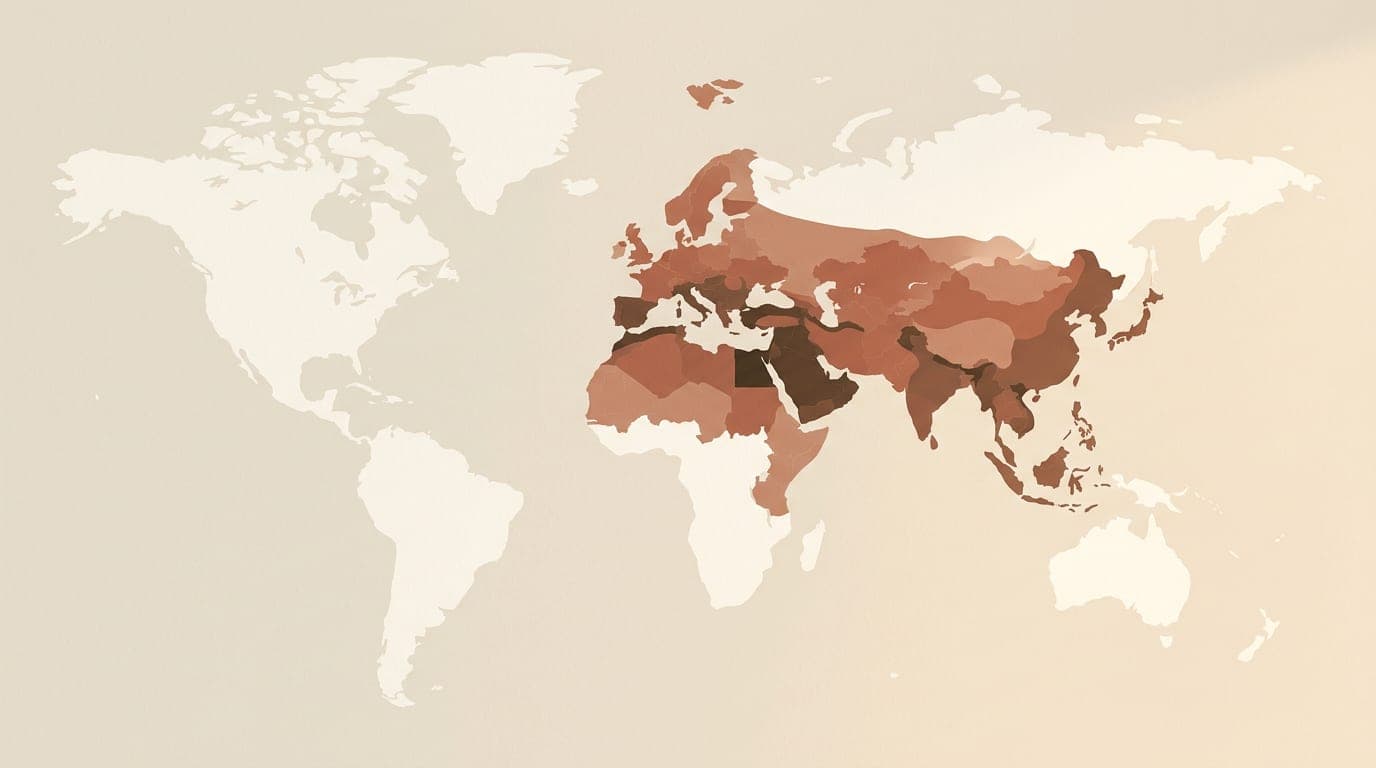
Native range — Europe, Africa, Middle East, parts of Asia. No wild hedgehogs in the Americas, Australia, or sub-Saharan southernmost Africa.
Hedgehogs live across Europe, most of Africa, parts of the Middle East, and parts of Asia. They are not native to North America, South America, Australia, New Zealand, or sub-Saharan southernmost Africa. The hedgehog you might see in a British garden is a different species from the one you might own as a pet, and neither lives anywhere in the wild in the United States.
Knowing where each species lives matters more than it sounds, because the wild habitat is what your captive hedgehog evolved for. The pet hedgehog (African pygmy) comes from warm grassland and won't survive a temperate winter. The European hedgehog you might see in a UK garden hibernates naturally and would die in an unheated room set to "tropical" indoor temperatures. Every care decision traces back to where the species originally lived.
The map, in plain words
There are 17 hedgehog species. They distribute across four broad regions:
Europe. The European hedgehog (Erinaceus europaeus) covers most of Western and Central Europe, the UK, Ireland, parts of Scandinavia, and into European Russia. The Northern white-breasted hedgehog (Erinaceus roumanicus) covers Eastern Europe and into Asia.
Africa. Several Atelerix and Paraechinus species spread across most of the continent except the southernmost tip and the deep Sahara. The African pygmy (Atelerix albiventris): the species your pet traces back to. Covers central Africa from Senegal across to Ethiopia and down through parts of East Africa. The Algerian hedgehog (Atelerix algirus) covers North Africa, parts of southern Europe, and the Mediterranean.
Middle East and Asia. The long-eared hedgehog (Hemiechinus auritus) and the Indian long-eared hedgehog (Hemiechinus collaris) cover dry parts of the Middle East and South Asia. The Daurian hedgehog covers Central and Northeast Asia.
Where they don't live in the wild. No native hedgehogs in the Americas (North, Central, South), no native hedgehogs in Australia or New Zealand, no native hedgehogs in sub-Saharan southernmost Africa, and none in Antarctica (obviously).
If a friend tells you they've seen a wild hedgehog in their backyard in Idaho, they almost certainly haven't. They've probably seen an opossum (commonly mistaken from a distance), a young porcupine (very different family), or some other small mammal. Hedgehogs in North America exist as pets only.
What habitat each species actually lives in
The species names matter less than the habitat patterns, because habitat is what tells you about care.
European hedgehog. Temperate gardens, hedgerows, woodland edges
Where: UK, Ireland, most of Western and Central Europe.
Habitat: Mixed deciduous woodland edges, hedgerows (which give them their name), suburban gardens, parks. They've adapted unusually well to human-modified landscapes. Many UK hedgehogs live their whole lives in suburban gardens.
Climate: Temperate. Cold winters, mild summers. Seasonal rainfall.
What this means: European hedgehogs hibernate. From roughly November to March (varying by latitude), they slow their metabolism dramatically and den up in leaf piles, brush, or burrows. They've evolved for this. Captive European hedgehogs can hibernate normally. But pet African pygmies cannot, which is why you can't keep one species like the other.
African pygmy hedgehog. Sub-Saharan grassland and scrub
Where: Central Africa, ranging from Senegal through Ethiopia and into parts of East Africa.
Habitat: Open grassland, scrub, savanna edges, semi-arid regions. They use existing burrows (often abandoned by other animals), termite mounds, brush piles, and rock crevices for daytime shelter.
Climate: Warm year-round. Daytime temperatures typically 75–95°F; nighttime drops but rarely cold. Distinct dry and wet seasons but no real winter.
What this means: African pygmies didn't evolve for cold. They have no real hibernation behavior. What looks like hibernation in a captive African pygmy is actually torpor, an emergency response to dangerously low temperatures, and they often don't recover. This is why every care guide insists on 72–80°F constant ambient temperature. It's not pampering. It's matching their species range.
Long-eared hedgehog. Arid Asia and Middle East
Where: Dry regions across Central Asia, Iran, Afghanistan, and parts of the Middle East.
Habitat: Arid scrubland, desert margins, rocky terrain. Distinctive long ears help with thermoregulation in heat.
Climate: Hot, dry. Temperature swings can be significant between day and night.
What this means: Long-eared hedgehogs are even more heat-tolerant than African pygmies and can handle drier air. They're rarely kept as pets in North America (they're not part of the established US pet trade) and their care needs differ enough that they shouldn't be lumped in with African pygmy advice.
Urban hedgehogs. When wildlife meets cities
In some of their native ranges, hedgehogs have moved into human-modified landscapes successfully. The most documented case is the European hedgehog in UK suburbs, where they've become familiar enough that the British Hedgehog Preservation Society runs ongoing population monitoring. Densities can be 1–2 hedgehogs per hectare in good suburban habitat. Better than in many "natural" environments.
This isn't always good news. UK hedgehog populations have declined sharply over the last 30 years (estimated 30–75% loss depending on the source), driven by:
- Loss of hedgerows in agricultural areas
- Increased garden tidiness (less leaf litter, fewer brush piles for shelter)
- Solid garden fencing that creates impassable barriers
- Vehicle strikes on suburban roads
- Pesticide use reducing insect prey
Urban hedgehog populations in Europe are now the focus of significant conservation work. If you're in the UK or Ireland and want to help, leaving a small "hedgehog hole" in your garden fence (about 13×13 cm) lets local hedgehogs move between gardens and meaningfully helps regional populations.
Why this matters for captive care
Connecting back to why "where do hedgehogs live" is more than a trivia question:
Temperature. Your captive African pygmy needs the temperature of their native range, not your house. 72–80°F constant. This is the most-violated husbandry rule in the hedgehog world and the leading cause of preventable deaths.
Humidity. Their native range is moderately humid in wet season, drier in dry. Captive hedgehogs do fine at 40–60% relative humidity. Below 30% causes dry skin and quill issues; above 70% encourages mites and fungal infections.
Light cycle. They evolved at sub-Saharan latitudes. Roughly 12 hours of light, 12 of dark, year-round. Captive hedgehogs do best with consistent light cycles in that range. Big seasonal shifts in artificial light can disrupt their behavior and weight cycles.
Substrate. They evolved on grassland and dry leaf litter, not on shavings, not on paper. Fleece liners are popular because they're soft, washable, and don't mimic any wild material so they don't trigger any specific instinctive behavior. Wood shavings are the most controversial substrate. Comfortable for some, allergenic for others.
Hide. Wild hedgehogs use pre-existing burrows. A captive hide that lets them fully disappear (covered top, single small entrance) replicates this and most visibly prefer it over open shelters.
The pattern: captive husbandry that works is captive husbandry that approximates the species' native range. When advice contradicts what the species actually evolved for, default to the species.
A quick reference
| Species | Native to | Climate | Hibernates? | Pet? |
|---|---|---|---|---|
| African pygmy (Atelerix albiventris) | Sub-Saharan Africa | Warm year-round | No | Yes. The standard pet |
| Algerian (Atelerix algirus) | North Africa, S. Europe | Mediterranean | Briefly | Hybridized into the pet line |
| European (Erinaceus europaeus) | UK, Europe | Temperate | Yes (Nov–Mar) | No. Protected wildlife |
| Northern white-breasted (Erinaceus roumanicus) | Eastern Europe, W. Asia | Temperate | Yes | No |
| Long-eared (Hemiechinus auritus) | Central Asia, Middle East | Arid, hot | Briefly | Rarely, not in NA |
| Indian long-eared (Hemiechinus collaris) | South Asia | Arid, hot | No | No |
| Daurian | Central/NE Asia | Variable | Yes | No |
| Other African species (Somali, Southern, etc.) | Various African regions | Varies | No | No |
The full taxonomy includes some recently re-described species we've omitted for clarity. For the current authoritative list, see the IUCN Red List Erinaceidae entries linked in the sources below.
What if I find a hedgehog outdoors?
This depends on where you are:
In the UK, Ireland, or continental Europe. You've probably found a wild European hedgehog. If it's healthy and out at night, leave it. If it's out during the day, looks injured, looks dehydrated, or is a young hedgehog out alone in winter. Take it to a licensed wildlife rehabilitator. The British Hedgehog Preservation Society maintains a rehabilitator directory for the UK; equivalent organizations exist for most other countries in their native range.
In Africa, Middle East, or Asia in their native range. Same general principle. Leave healthy wild animals alone, route injured ones through local wildlife services if available.
In North America, South America, Australia, New Zealand. You haven't found a wild hedgehog. There aren't any. Either it's an escaped pet (bring it indoors immediately, check for missing-pet reports), or it's a different animal. Common look-alikes include opossums (very different but similarly small and nocturnal), young porcupines, and some rodent species.
Common questions
Common questions
Are there hedgehogs in North America?
Not in the wild. Hedgehogs are not native to North America. Every hedgehog in the US, Canada, or Mexico is either a pet, an escaped pet, or — in rare cases — a wildlife-park animal under permit. If you've seen a 'wild hedgehog' in your American backyard, it was almost certainly an opossum, a porcupine, or another small mammal.
Where do European hedgehogs live?
Across most of Europe, the UK, parts of Scandinavia, and into European Russia. They're a familiar garden animal in much of the UK and Ireland. They're protected wildlife in their native range — see our species guide for legality details.
Where do African pygmy hedgehogs live in the wild?
Sub-Saharan Africa, particularly across central Africa from Senegal to Ethiopia and down through parts of Tanzania. Their habitat is grassland, scrub, and semi-arid regions — warm year-round, with seasonal rainfall but no real cold season.
Why does this matter if I just want one as a pet?
Because the pet hedgehog evolved for a warm climate with no winter. They don't naturally hibernate; in captivity, hibernation attempts triggered by cold can kill them. The 72–80°F constant-temperature rule isn't arbitrary — it matches their native range. Skip the heat lamp and you're putting a sub-Saharan animal through a temperate winter.
Do hedgehogs live in burrows?
Yes, more or less. Wild hedgehogs use pre-existing burrows (often dug by other animals), brush piles, and dense vegetation as daytime shelter. They emerge at dusk to forage and return before dawn. In captivity, a covered hide replicates this — and most hedgehogs visibly prefer a hide they can fully disappear into versus an open shelter.
Related on this site
Sources
Sources
- Atelerix albiventris distribution map and habitat — IUCN Red List
- Erinaceus europaeus distribution and ecology — IUCN Red List