
Hedgehogs 101 · 8 min read
Are Hedgehogs Good Pets for Kids? The Honest Parent's Answer
Mostly no for kids under 12, sometimes yes for teens with parent backup. The handling failure modes, the supervision required, and the safer alternatives.
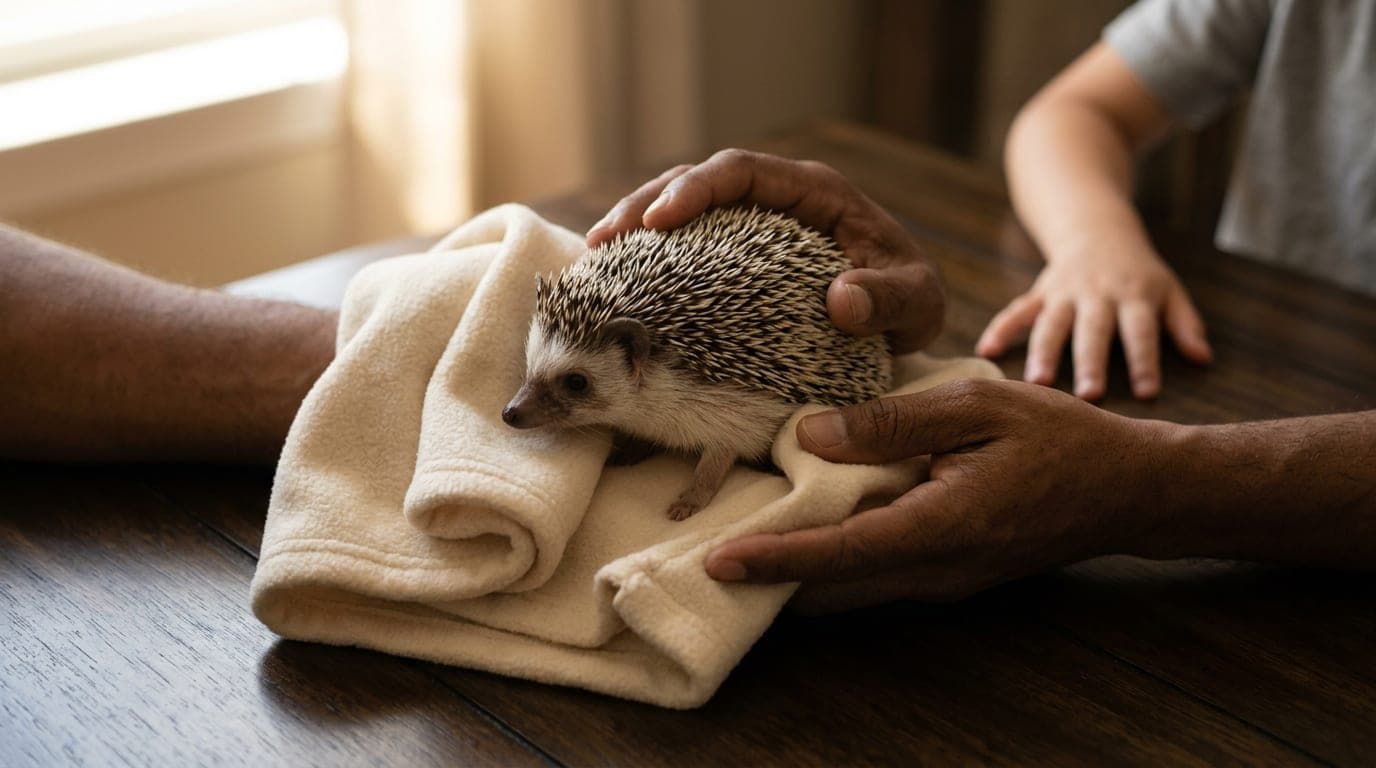
Supervised handling · adult-led · kid as observer
A hedgehog is a poor first pet for a child under 12, a marginal pet for kids 12 to 15, and a workable pet for teenagers and adults. The animal you're considering is nocturnal, often anti-social for the first month, prickly when startled, and requires patient evening handling that the average child can't reliably bring. The owners who succeed with kid-and-hedgehog households are parents who accept that they are the real owner and the kid is the supervised participant.
This is the friendly-pet decision most pet sites refuse to make honestly. We're making it.
Why hedgehogs and younger kids usually don't mix
Five practical reasons, in roughly the order they matter.
They're nocturnal
The hedgehog is asleep when your kid gets home from school. The hedgehog wants to be awake at 9pm, 10pm, midnight, and 2am. The window when the kid is awake and the animal is naturally social is narrow. Pulling them out for daytime visits stresses the animal and produces the worst version of the pet (defensive, balled-up, unresponsive).
A child who can't reliably stay up past 9pm to handle the pet at the animal's natural waking hour is a child whose interaction window is mostly when the pet is asleep. That's a bad relationship pattern for everyone.
They're not naturally social
A dog wants you. A cat tolerates you and sometimes seeks you out. A hedgehog accepts your presence after weeks of patient handling and never reciprocates the bond the way a child expects. The kid who's been promised a "pet they can love" is going to be disappointed in week three.
This isn't the hedgehog's fault. They're solitary animals in the wild. Captivity hasn't changed that. But it does mean the emotional rewards a child expects from a pet (greeting at the cage, snuggling, visible affection) aren't really on offer.
They have quills
A startled hedgehog balls up. A balled-up hedgehog held by a young kid can prick the kid's hand. The kid drops the hedgehog. The hedgehog hits the floor or a hard surface and can suffer real injury. This sequence happens often enough that experienced owners specifically advise against young children handling unsupervised.
The quills aren't barbed. They don't break off in skin. A prick is briefly unpleasant, not dangerous. But the surprise reaction is the dangerous part for the animal.
They require careful daily handling technique
Picking up a hedgehog isn't intuitive. You scoop from underneath, you let them unfurl on their own time, you don't squeeze, you don't grab from above, you don't pull a balled-up hedgehog apart. A 7-year-old who's excited about their new pet will get one or more of these wrong on the first try. The animal learns that humans are unpredictable and stays defensive longer.
The age at which most kids can reliably do this is around 11 or 12, and even then with practice and parental coaching. Younger kids should observe handling, not perform it.
They carry salmonella
Hedgehogs, like reptiles, carry salmonella as part of their normal gut flora. They themselves don't get sick from it. Humans who don't wash their hands after handling can. The CDC has issued specific guidance on hedgehog handling for exactly this reason. Children under 5 are at higher risk for salmonella complications and should not handle hedgehogs at all.
For older kids, the requirement is non-negotiable hand-washing immediately after handling, before any food contact, before touching their face. This is doable. It's also a discipline that not every household enforces consistently.
The 12-and-up exception
For kids 12 and older, hedgehogs can work, but with conditions:
The parent is the real owner. If the kid loses interest at 14 (most kids lose interest in their pets at some point), the parent has to be willing to take over fully. If you're not willing to commit to a 5+ year animal regardless of your kid's enthusiasm trajectory, this isn't the right pet.
The kid has demonstrated low-maintenance pet responsibility first. A child who's reliably cared for a hamster, a guinea pig, or even a planted aquarium for at least a year has shown the consistency that hedgehog care requires. A child who's been begging for a pet but hasn't been responsible for one is not yet ready.
Supervised handling, not solo. Even at 12+, the first six months of handling should be with a parent present. The kid learns technique; the parent catches mistakes.
Honest commitment from the start. The parent and kid sit down before purchase and agree explicitly: this is the parent's animal that the kid helps with. Not the other way around. This framing prevents the disappointment of "but you said it was mine" when the kid loses interest.
What younger kids can safely do with a household hedgehog
If you decide to bring a hedgehog into a home with younger kids despite the above, there are roles a child under 12 can usefully play:
- Watching from outside the cage. Hedgehogs are interesting to observe. Wheel running, exploring, eating, the occasional self-anoint — all good silent-observation material.
- Helping refresh food and water. Under supervision, kids can scoop kibble or refill the water bowl. Builds the daily-care habit.
- Reading the cage thermometer and reporting. Lower-stakes responsibility that builds awareness.
- Helping with spot cleaning of the cage with adult tools and supervision.
- Brief, supervised handling sessions of 5 to 10 minutes with the parent holding the animal and the kid sitting nearby touching the back gently.
What younger kids should not do:
- Pick up the hedgehog themselves
- Carry the hedgehog around the house
- Take the hedgehog out of the cage without an adult present
- Handle the hedgehog and then eat without hand-washing
- Show the hedgehog to friends without adult supervision
Why "they're so cute" isn't enough
This section is for the parent reading this because their kid showed them a viral hedgehog video. We've watched the same videos. The hedgehogs in those videos are usually:
- Already established with their owner (the adult)
- Filmed during their natural waking hours (evening)
- Edited to remove the boring parts and the defensive balling
- Often in poses that look cute but are actually stressful for the animal
The 30-second TikTok of a hedgehog eating a strawberry from a tiny spoon is the best 30 seconds of a 24-hour day. The other 23 hours and 59 minutes are the hedgehog being a hedgehog. Mostly asleep, mostly indifferent, mostly nocturnal.
If your kid loves the videos and that love is what's driving the request, the question to answer honestly is: are they going to love the 23-hour-59-minute version too? Most kids will not. That's not a moral failure. It's just that the marketing version of hedgehog ownership and the reality don't line up.
Honest alternatives for younger kids
If your kid wants a pet, and a hedgehog isn't right, the better first-pet options:
Guinea pigs
The best small-mammal starter pet for kids in our opinion. Diurnal (awake during the day, when the kid is also awake), vocal (they squeak when happy and when hungry, which gives kids feedback), social (they bond with humans, sometimes intensely), forgiving of imperfect handling, and long-lived enough (5 to 7 years) to be a real childhood pet without becoming an immediate grief experience.
Downsides: they need a buddy (always at least two), they need more floor space than people expect (8 sq ft minimum for two), and they have specific diet requirements (vitamin C, hay always available).
Rats
The public image is bad and the actual animal is wonderful. Domestic rats are intelligent, social, bond with humans, and learn basic tricks. They're also short-lived (2 to 3 years), which is a real downside for a young child experiencing pet loss.
Always at least two (they're highly social), and ideally female (males can develop aggression issues). A solo rat is a depressed rat.
A planted aquarium with hardy fish
Less interactive but excellent for teaching the daily-care habit. Live plants and a few hardy fish (white cloud minnows, ember tetras, dwarf shrimp) require routine feeding, water testing, and occasional water changes. The kid can take real ownership without an animal-handling risk to the pet.
Cat or small-breed dog
If your household is right for it. A cat or low-energy small dog gives a child the social pet experience they're actually imagining when they ask for a "pet." Bigger commitment than a small mammal, but better matched to what most kids actually want.
When hedgehog-and-kid does work
For balance, the cases we've seen work well:
- The 14-year-old who's been keeping a guinea pig for three years. Demonstrated responsibility, age-appropriate handling skill, parent backup if interest wanes.
- The 12-year-old whose parent is the actual hedgehog enthusiast. Kid participates and learns, parent owns. Both happy.
- The homeschooled kid with an unusual amount of time to invest. Daytime visits to the cage to refresh food, evening handling with a parent, deep interest in the species itself. These kids exist and they often do better with exotic pets than with conventional ones.
- The teenager who specifically researched hedgehogs and made a case to the parent. Independent interest combined with parent agreement. The kid is usually going to put in the work.
What these cases share is that the kid wanted a hedgehog specifically, not a generic "pet," and the parent stayed engaged rather than treating it as the kid's project.
The honest summary for parents
If you've read this far, you probably already know what we're going to say. A hedgehog is mostly the wrong pet for a younger kid, occasionally the right pet for a teen with parent backup, and never the right pet for a parent who's planning to hand it off to a child and walk away.
If the answer is "still maybe," do two things before committing:
- Visit a hedgehog at a reputable breeder or rescue with your kid. See how they react to the real animal, not the video version.
- Spend an hour reading the full daily care guide together. The unfun parts are most of the reality.
If both parent and kid still want the animal after that, you're probably the rare case where it works. Get the hedgehog. Just be honest with yourselves about who's actually the owner.
Common questions
Common questions
What age is appropriate for a child to have a hedgehog?
Most experienced hedgehog owners would say 12+ as a minimum, with an engaged parent who treats the animal as their own. Younger kids can be involved (helping with feeding, watching, sometimes briefly holding under supervision) but should not be the primary caretaker. The animal's safety and the child's relationship with pets both depend on adult ownership.
Are hedgehogs friendly to kids?
Not naturally. Hedgehogs are not social animals in the way dogs or cats are. They tolerate handling at best; they don't seek it out. A child expecting a pet that runs to greet them or wants to cuddle will be disappointed. A child who's content to quietly observe an animal do its thing might be a good match.
Can hedgehogs hurt children?
Direct injury is rare. Hedgehog quills can prick if the animal is startled and balls up while being held, but they don't actively attack. The bigger safety issue runs the other way — kids dropping hedgehogs, squeezing too hard, or letting them fall from a height. A dropped hedgehog can suffer real injury. They also carry the same salmonella risk as reptiles, so hand-washing after every handling session is mandatory.
What's a better first pet for a young child?
Guinea pigs are the best small-mammal starter pet for kids — diurnal (awake during the day), vocal, social, easier to handle, and forgiving of imperfect care. Rats are also excellent first pets despite the public image — intelligent, sociable, bond with their humans. A planted aquarium with a few hardy fish is another low-stress option that teaches care responsibility.
My child really wants a hedgehog. How do I handle that conversation?
Don't dismiss the interest — channel it. Visit a reputable breeder or rescue with your child so they can meet an actual hedgehog in person. Read articles like this one together. Have your child read about the daily care commitment and the not-fun parts (the cleaning, the 2am noise, the wheel poop). If they're still enthusiastic after the realistic picture, you can either commit (with you as the real owner) or pick a better-matched alternative. The interest in animals is good; the specific animal can be redirected.
Related on this site
Sources
Sources
- African pygmy hedgehog — basic information, temperament, and ownership considerations — LafeberVet
- Salmonella risk associated with hedgehogs and other exotic small mammals — U.S. Centers for Disease Control and Prevention (CDC)