
Health & Vet Care · 7 min read
Do Hedgehogs Hibernate? Why Captive Hibernation Can Kill Them
African pygmy hedgehogs should never hibernate in captivity. If your hedgehog feels cold or is unresponsive, it's a medical emergency. Steps to take now.
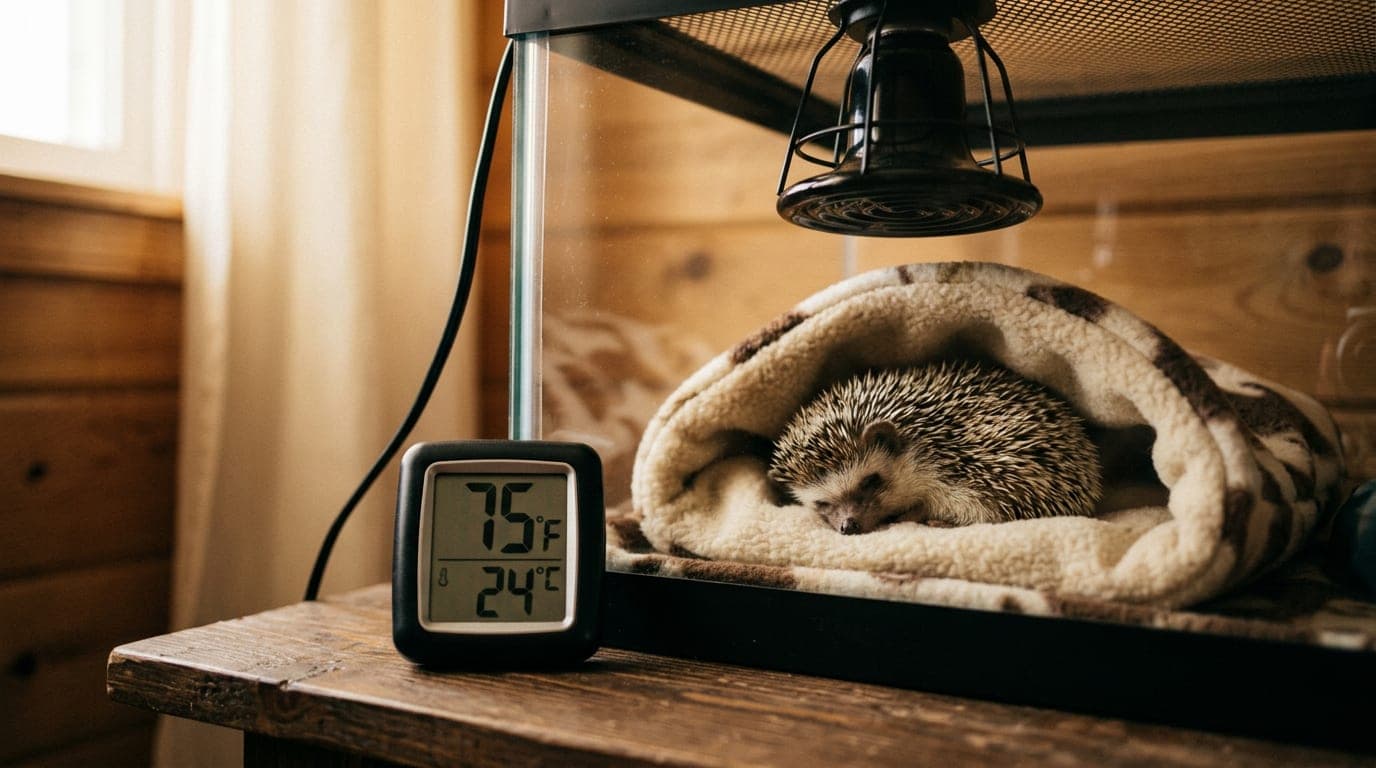
Prevention · 75°F · year-round · no exceptions
No. Pet African pygmy hedgehogs should never hibernate. If your hedgehog feels cold to the touch or is unresponsive, this is a medical emergency. Warm them slowly against your bare skin under a soft cloth, set the room temperature to 75°F, and call an exotic-animal vet immediately. Do not warm them with a heat source (heating pad, hair dryer, hot water). Do not wait to see if they "wake up." This guide explains what's happening, what to do, and how to prevent it from happening again.
What hibernation actually is in hedgehogs
Hibernation is a metabolic state where the body slows down dramatically: heart rate drops, breathing becomes shallow, body temperature falls to within a few degrees of the environment, and the animal becomes unresponsive. Some species do this safely; they evolved for it. They build up fat stores in autumn, their cells produce specific proteins that protect against the cold, and they wake gradually when conditions improve.
African pygmy hedgehogs did not evolve any of this. They came from equatorial Africa where the ambient temperature rarely drops below 60°F even at night. They have no fat-storage cycle tied to the season, no cold-protection proteins, no metabolic preparation for a long sleep. When their body temperature drops, they slow down because they're freezing, not because they're hibernating safely.
The state called "attempted hibernation" or "hibernation attempt" in pet hedgehogs is more accurately described as hypothermia. The animal's body is shutting down because the temperature is wrong, not because it's running a planned cycle. Most do not recover without intervention.
How to tell if your hedgehog is trying to hibernate
The signs, in roughly the order they show up:
- Cold to the touch. Especially on the belly. A healthy hedgehog feels warm. A hibernating one feels cool or cold.
- Sluggish movement. Slower than usual, possibly stumbling, not unfurling when you pick them up.
- Reduced or absent appetite. Refusing food they normally eat.
- Quivering or shivering. Sometimes visible, sometimes felt as a fine tremor.
- Reduced breathing rate. Breaths become slower and shallower.
- Unresponsiveness. Doesn't react to handling, voice, or stimulation.
- Sometimes a "wobbly" walk or inability to right themselves.
If any of these appear, especially #1 and #6, treat it as an emergency. Time matters.
What to do right now if you suspect hibernation
The protocol used by exotic-animal vets:
Step 1: warm them with body heat, not external heat
Place the hedgehog against your bare skin (chest, belly, or inside a t-shirt) under a soft cloth. Body heat is the safest warming source because it can't overheat them or burn them.
Do not use a heating pad, hair dryer, hot water bottle, hot water, oven, microwave, or any direct heat source. Sudden heat applied to a cold animal can cause shock and tissue damage. The warming has to be gradual.
Step 2: raise the room temperature
Turn up the heat to 75 to 80°F. Close windows, turn off AC. If the room can't get warm enough quickly, move to a smaller warm space (a bathroom with the door closed and a space heater running across the room, never directly aimed at the animal).
Step 3: call an exotic-animal vet now
This is not a wait-and-see situation. Even if your hedgehog warms up and seems okay, there can be internal damage that isn't visible. A vet visit within 24 hours is appropriate even for a "recovered" hibernation attempt.
If you don't already have an exotic vet, the vet directory guide walks through finding one. Animal poison control lines and 24-hour emergency vets are backup options if your usual vet isn't reachable.
Step 4: keep them warm while traveling
If you have to drive to a vet, keep the hedgehog against your body in a soft carrier. Do not turn the car heater on high directly on them. Maintain consistent gentle warmth, not a heat blast.
What recovery looks like
A hedgehog that wakes from an attempted hibernation usually:
- Starts to stir within 20 to 40 minutes against your body
- Begins to move and explore once their body temperature is back up
- Shows interest in food and water within a few hours
- Returns to mostly normal activity within 24 hours
What's not okay:
- No response to warming after 40 to 60 minutes
- Continued lethargy 24 hours after the event
- Refusing food or water once warmed
- Wheezing, weakness in the legs, or any neurological signs
Any of these means follow-up vet care is essential.
Why this happens — the temperature trigger
In almost every case, an attempted hibernation traces back to a room or cage that got too cold for too long. The common causes:
- AC running in summer that pushes the room below 72°F overnight. Common in hot climates where the AC over-corrects at night.
- Heat source failure. The ceramic heat emitter burns out, the thermostat malfunctions, or a power outage cuts the heat. Most owners don't catch this for hours.
- Drafts. A cage near a window or a poorly-insulated wall can get colder than the rest of the room, especially in winter.
- Travel. A hedgehog moved between locations (car, friend's house, kennel) can experience a temperature drop the owner didn't notice.
- Hot water heater or HVAC repairs. Brief loss of heat in the house can be enough.
- Moving them to a cold room temporarily (a garage, an unheated basement) without realizing how cold it had become.
Some hedgehogs are more sensitive than others. We've seen animals attempt hibernation at 70°F when most would not show symptoms above 65°F. If you've had a previous hibernation incident, your hedgehog is more likely to attempt it again at the same threshold. Adjust upward.
How to prevent this from happening at all
Three things prevent almost every hibernation incident:
1. Maintain 72 to 80°F year-round
This is the single most important hedgehog care rule. Year-round means in August with AC running, in January during a cold snap, when you're traveling, when the power's flickered. There is no exception.
The heat lamp guide walks through specific equipment. The short version: ceramic heat emitter (CHE) on a thermostat, mounted above the cage, with a digital thermometer inside the cage measuring the actual cage temperature (not the ambient room temperature, which is often 3 to 5°F warmer).
2. Build in redundancy
Heat sources fail. The way you prepare for that:
- Two thermometers. One in the cage, one on the wall nearby. If the cage thermometer disagrees with the room one by more than a few degrees, something's wrong.
- A backup heat source. A second CHE in a separate fixture, or a space heater you can deploy if the primary fails.
- A monitored alarm. Some thermostats have alarms when temperature drops out of range. A simple wifi thermometer with smartphone alerts ($30 to 50) does the same job.
3. Check the cage temperature daily
Glance at the cage thermometer every time you refresh food. If it's reading anywhere below 73°F, something needs adjustment. Daily checks catch slow drift before it becomes an incident.
What about wild European hedgehogs?
European hedgehogs (Erinaceus europaeus) — the species native to the UK and continental Europe — do hibernate in the wild from roughly October to April depending on climate. They're physically adapted for it: they build fat reserves, their bodies produce specific cold-tolerant proteins, and they wake gradually in spring.
Even European hedgehogs in wildlife rehabilitation centers don't always hibernate safely. Animals that arrive underweight in autumn often need to be kept warm and fed through the winter rather than allowed to hibernate, because their fat reserves aren't sufficient.
Almost no pet hedgehog in North America is a European hedgehog. They're almost all African pygmy hedgehogs (Atelerix albiventris) or hybrids. The species you have in a cage in your home does not hibernate.
What about Algerian or Egyptian hedgehogs?
Other species occasionally kept as pets in some regions:
- Algerian hedgehog (Atelerix algirus). Native to North Africa, climate similar to African pygmy range. Should not hibernate in captivity for the same reasons.
- Egyptian or long-eared hedgehog (Hemiechinus auritus). Native to drier regions of North Africa and the Middle East. May enter brief torpor in extreme heat (estivation) in the wild but should also be kept at stable temperatures in captivity.
The rule of thumb: any pet hedgehog in North America should be kept at 72 to 80°F year-round regardless of species. If you're keeping a less common species and aren't sure, ask the breeder or rescue directly about temperature preferences.
A note for owners who've been through this
We hear from new owners who've had a hibernation incident and felt terrible about it. It's worth saying clearly: most hibernation incidents in pet hedgehogs trace back to a heat source failure or a temperature drop the owner didn't catch, not to negligence. The animal isn't supposed to hibernate; you're not supposed to be on 24/7 thermometer watch.
If you've had an incident:
- Get your hedgehog evaluated by a vet, even if they seem recovered.
- Audit your heat setup. Add the redundancy described above.
- Don't blame yourself, but do upgrade the system.
A second hibernation attempt is more likely than the first, and tends to be harder to recover from. The owners who succeed with hedgehogs long-term are the ones who treat temperature management as the foundation everything else sits on.
When to involve a vet — even after recovery
Schedule a vet visit if you observe any of the following in the 7 days after a hibernation incident:
- Continued lethargy or reduced appetite
- Weight loss
- Difficulty walking or weakness in the back legs
- Skin issues, especially on parts of the body that were cold
- Refusing food they normally enjoy
- Any wheezing, clicking, or breathing changes
Hibernation incidents can have delayed effects, including secondary respiratory infections, neurological symptoms, and digestive disruption. A 15-minute vet appointment within a week of the event is cheap insurance against missing something.
The full warning signs guide covers what counts as a vet visit in general; this section is specific to post-hibernation observation.
Common questions
Common questions
How can I tell if my hedgehog is hibernating?
A hedgehog attempting hibernation feels cold to the touch, especially on the belly. They become unresponsive or sluggish, breathing slows visibly, and they may not unfurl when handled. Some quiver or have a rough texture to their skin. If you suspect this, treat as an emergency — warm them slowly against your bare skin under a soft cloth and call an exotic vet now.
How long can a hedgehog stay in hibernation?
Captive African pygmy hedgehogs cannot survive prolonged hibernation. Their bodies aren't equipped for it (no built-up fat stores, no metabolic preparation, no cold-adapted physiology). Most cannot recover after more than a few hours in a true hibernation state. This is why immediate action matters.
What temperature do hedgehogs hibernate at?
The trigger temperature for attempted hibernation is typically below 72°F (22°C) sustained over several hours. Some hedgehogs are more sensitive than others. The safe range is 72–80°F (22–27°C) year-round. Avoid temperature drops at night, during AC use in summer, and during travel.
What's the difference between hibernation and being sick?
Hibernation attempts are triggered by cold; sickness usually has other signs (discharge, breathing problems, refusing food for days). The two can also overlap — a sick hedgehog is more vulnerable to cold. Either way, an unresponsive cold hedgehog needs a vet, not waiting.
Do European hedgehogs hibernate?
Yes — wild European hedgehogs (Erinaceus europaeus) and other European species hibernate naturally from about October to April depending on climate. They are biologically adapted to it. The pets sold in North America are almost always African pygmy hedgehogs (Atelerix albiventris), a tropical species that does not hibernate naturally and cannot do so safely in captivity.
Related on this site
Sources