
Behavior & Handling · 8 min read
How to Bond With a Hedgehog (Without Driving Yourself Crazy)
Hedgehog bonding takes 4–8 weeks for most, never for some. The realistic timeline, what works, what doesn't, and how to know they're warming up to you.
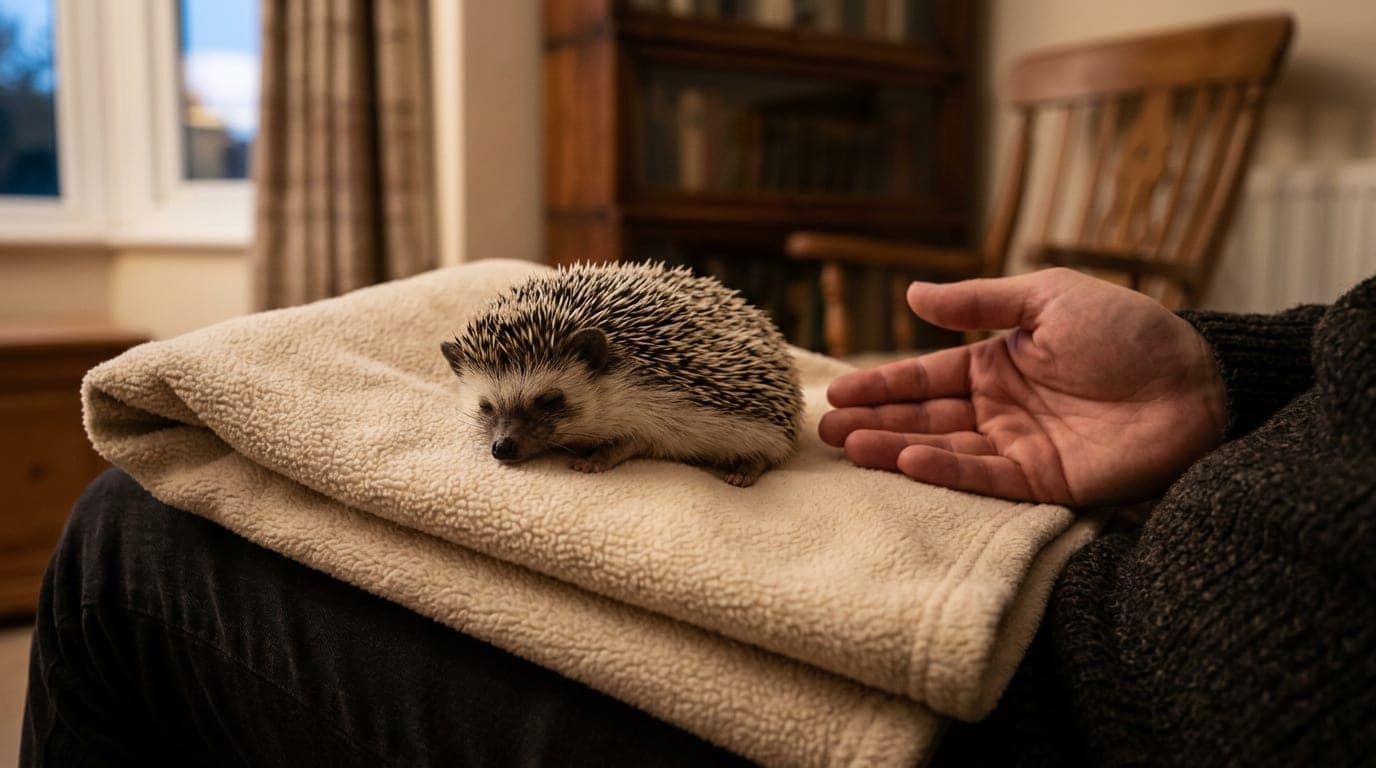
What bonded looks like · quills flat · relaxed presence
Bonding with a hedgehog takes patience most new owners aren't prepared for. The animal you brought home is not a dog. It's not even a cat. It's a small solitary insectivore that evolved without much use for socializing with anything, including other hedgehogs. The good news is that captivity-bred African pygmies do learn to recognize and trust specific humans. The harder news is that this recognition takes 4 to 8 weeks of patient daily handling, and a small percentage of hedgehogs never fully relax with humans at all. Both are normal. This guide is what experienced owners actually do.
What "bonding" really means for a hedgehog
Forget what you know about bonding from dogs and cats. A hedgehog doesn't develop the kind of affectionate attachment those species do. They don't seek out human attention, they don't try to please you, they don't feel happiness at your return.
What a bonded hedgehog does:
- Recognizes your scent and reacts less defensively to your hand than to a stranger's
- Flattens their quills when picked up (or doesn't fully erect them), versus the spiky-up defense of an unfamiliar animal
- Unfurls faster when handled, sometimes within seconds rather than minutes
- Explores your hand or lap instead of trying to leave immediately
- Occasionally falls asleep on you during evening handling — usually the strongest sign of trust
- Stops huffing at routine cage interactions like food refresh
That's the ceiling. It's a relationship of accepted handling, not affection in the mammalian-pet sense. Owners who can recalibrate to this benchmark find hedgehog ownership genuinely rewarding. Owners who keep expecting cat-or-dog bonding feel like failures even when the bonding is working.
The mechanism: scent before everything
Hedgehog vision is poor. They navigate the world primarily by smell. This is the single most useful fact for bonding work.
What this means practically:
- Your scent is your bonding tool. Not your voice (they don't really respond to voices the way dogs do). Not eye contact. Not body language. Your specific scent, present in their environment.
- The scent transfer technique works. Sleep with a small piece of fleece (the same fleece you'll use as a cage liner or hide blanket) for one or two nights. Then place it in their cage. Repeat every few days. They wake up, smell you, and over time learn that this scent is associated with safety.
- Wash your hands before handling, but not too much. Strong-smelling soap, perfume, lotion, or recent food prep on your hands is more disorienting than calming. Plain unscented soap, water, dry off, then handle.
The scent-first principle also explains why hedgehogs sometimes seem to favor one person in a household: that person is the one whose scent they encounter most often during handling. It's not personality preference. It's olfactory familiarity.
A realistic four-week timeline
Week-by-week, what most owners actually experience.
Week 1: leave them mostly alone
The first three days, no handling. Place a worn t-shirt or piece of your fleece in their hide. Refresh food and water in the evening, then leave. The cage is enough new stimulation for them.
Days 4 through 7: very short handling. 5 to 10 minutes in the evening, on your lap, on a soft cloth. Let them ball up. Don't unroll them. Just sit and let them feel that nothing scary is happening. If they unfurl on their own, that's a win. If they stay balled the whole time, also fine. Either way, you've started the routine.
By day 7, most hedgehogs will have unfurled at least once. They've also formed a very early association between your scent and "nothing bad happened."
Week 2: longer handling sessions
20 to 30 minutes nightly in the evening. Sit somewhere quiet, on a couch or floor, with a soft fleece blanket on your lap. Pick the hedgehog up by scooping from underneath, not grabbing from above. Place them on the blanket.
What you'll likely see: still some huffing and balling, but they may unfurl within 1 to 2 minutes now. They may take a few hesitant steps on your lap. They may try to climb off, which is fine — just guide them back gently.
What you should not do: pin them, force them to unfurl, talk loudly, make sudden movements, hand them to other people. The point is sustained low-stress contact, not socialization training.
Week 3: small experiments
Most hedgehogs by week 3 have learned that handling sessions are predictable and non-threatening. You can start small experiments:
- Hand-feeding a treat. A single mealworm or a tiny piece of mango from your palm. They'll initially be cautious; over a few sessions most learn to take food from a familiar hand without hesitation.
- Quiet talking. They don't understand words, but a calm consistent voice during handling becomes part of the "this is safe" pattern.
- Different surfaces. A different blanket, the couch instead of the floor. Small environmental changes that broaden their comfort zone.
What you'll see: longer unfurled periods, exploration of your lap, less defensive posture overall. Still some huffing at startles, which is normal lifetime behavior.
Week 4: recognition starts to show
By week 4, your hedgehog is beginning to distinguish you from other humans. The signs:
- Faster unfurling with you than with anyone else who tries to hold them
- Less defensive when you reach into the cage to lift them out
- Sometimes climbing onto your hand willingly when you place it down
- Reduced quill height during routine cage tasks
This is what bonding looks like. It's quiet, it's incremental, and it's specifically about reduced defensiveness rather than active affection.
Beyond week 4: the ongoing pattern
After the initial month, most of the bonding work is maintenance. Daily handling continues at 20 to 30 minutes a night. Patterns deepen rather than reverse.
What gets better over months:
- More sustained calm on your lap (some bonded hedgehogs fall asleep during handling)
- Less reaction to routine cage tasks
- Comfortable hand-feeding becomes a reliable interaction
- Recognition extends to your specific way of approaching the cage
What stays the same:
- Some startle huffing forever
- A balled-up response to sudden movements or unfamiliar handlers
- Independent personality — they're not following you around the room
What may surprise you: bonded hedgehogs sometimes show clear preference for one routine over another. Some prefer being held in a specific way. Some have specific times of evening they'd rather be left alone. Some develop a habit of running to a specific corner of their cage when you approach. These are personality quirks that emerge once the basic trust is established.
What works
The behaviors and habits that experienced owners report as most useful:
- Daily handling, no skip days. Especially in the first month. Skipped days early on slow the whole process.
- Evening sessions only. Daytime handling forces them awake at the wrong time and stresses both of you. After 7pm is the natural window.
- Worn-clothing scent transfer. Sleeping with a fleece piece, then giving it to the hedgehog, accelerates scent familiarity.
- Low-pressure presence. Sitting with them on a blanket, reading a book, watching TV. The activity matters less than the consistent calm proximity.
- Hand-fed treats. Once they're comfortable enough, a mealworm or piece of fruit from your fingers builds the positive association.
- One primary handler. Hedgehogs bond faster to one person than to a household. If two adults want to bond, one should take the first 4 weeks and the second can start adding in once the animal is settled.
- Quiet environment. Loud music, kids running by, dogs in the room — all increase stress. Pick a calm spot.
What doesn't work
The mistakes that slow bonding or prevent it:
- Trying to "wake" the hedgehog during the day. Forces stress, teaches them that humans are unpredictable.
- Unrolling a balled-up hedgehog. Never. Let them unfurl on their own timeline.
- Loud calling or whistling. Doesn't work for hedgehogs and adds stress.
- Treating them like a cat. They don't come when called, don't want chin scratches, don't enjoy being carried around.
- Showing the hedgehog to lots of people quickly. Multiple handlers in the first month confuse the scent-recognition process.
- Long handling sessions over 45 minutes. They get tired and stressed. Shorter sessions, more often, beat marathon ones.
- Punishment for huffing or balling. They don't understand consequences. All you do is increase their stress.
- Comparing to other people's hedgehogs. Some animals are naturally more social than others. Your animal is your animal.
Signs your hedgehog is warming up
The progress markers, in roughly the order they appear:
- Unfurls faster than last week. Even by seconds.
- Takes a few steps on your lap instead of staying still.
- Sniffs your hand without huffing.
- Stops huffing at routine cage tasks.
- Takes food from your fingers.
- Climbs onto your hand willingly.
- Explores your lap or chest area on their own.
- Falls asleep during handling.
- Shows clear preference for you over other handlers.
Most bonded hedgehogs reach steps 1 through 5 within 4 to 6 weeks. Steps 6 through 9 vary widely by individual hedgehog. Some hit step 8 quickly; others never do.
When to accept they're just not into it
Some hedgehogs, despite consistent patient daily handling, stay defensive long-term. The honest version: if you've handled daily for 3 months in the evening, used scent transfer, kept the environment calm, and your hedgehog still huffs constantly and stays balled up most of every session, that's the relationship you have.
This isn't a failure on your part. Hedgehog personalities vary as widely as any species, and a meaningful percentage are just on the more defensive end. The handling still matters: a daily-handled defensive hedgehog is healthier and easier to care for than one that's been left alone. But active affection isn't on offer.
What this looks like in practice:
- Cage tasks become easier even if handling sessions remain defensive
- Vet visits are less traumatic because they're used to being handled at all
- Quality of life is good — they're a fine hedgehog living a fine hedgehog life
- The owner's job is to keep handling daily anyway, not to demand a different relationship
The owners who keep loving their less-bonded hedgehogs are the ones who internalized that the animal is fine as they are. Forcing the relationship doesn't work and shouldn't be the goal.
The honest summary
Hedgehog bonding is real but quiet. It takes 4 to 8 weeks for most, longer for some, and never fully arrives for a few. The mechanism is scent recognition over time, not affection. The signs are reduced defensiveness, not active enthusiasm. The relationship you can build is genuine but limited compared to dog or cat ownership.
If that's enough for you, hedgehog ownership is rewarding in a way that no other pet really matches: the quiet observation of an animal doing its own thing with you as a non-threatening presence. If you wanted more than that, you may have wanted a different pet.
Either way, the daily 20 to 30 minutes is the work. The animal's individual personality is the rest. You can't shortcut either.
Common questions
Common questions
How long does it take to bond with a hedgehog?
Four to eight weeks is typical for most hedgehogs to relax with their owner. Some warm up faster (within two weeks); some never fully bond, even with patient daily handling. The first month sets the pattern — if you skip handling that first month, the window for socialization narrows significantly.
Why won't my hedgehog let me hold them?
Most often: they're new, they're scared, they don't recognize your scent yet, and they're using their natural defense (balling up, huffing) because that's what hedgehogs do when uncertain. Less often: they've had a bad early experience that made them more defensive than typical. Almost never: they 'hate you.' Hedgehogs don't have the social hardware for that kind of relationship.
Can a hedgehog love its owner?
Not in the way a dog or cat does. Hedgehogs recognize specific humans by scent and learn that certain people are associated with safety, food, and gentle handling. That recognition produces calmer behavior, easier handling, and (in some hedgehogs) a clear preference for one person over others. Whether that counts as 'love' is a question about definitions, not biology. What we'd say: a bonded hedgehog has chosen to be relaxed with you, which is real and earned.
What's the best way to get a hedgehog to like you?
Three things, daily, for at least a month: handle them in the evening (when they're naturally awake), use a worn t-shirt of yours as their hide liner so they learn your scent passively, and don't expect anything fast. The owners we know who bonded best were the ones who handled patiently without trying to make 'something' happen each session.
Will my hedgehog ever stop huffing at me?
Mostly yes, but not entirely. Bonded hedgehogs still huff when startled — it's a reflexive defense, not a sign of how they feel about you. What changes is the duration: a new hedgehog huffs at everything; a bonded one huffs at sudden movements and stops once they recognize you. Some hedgehogs are huffier than others as a personality trait, and that doesn't fully resolve.
Related on this site
Sources
Sources
- African pygmy hedgehog — temperament, handling, and socialization — LafeberVet
- Hedgehogs — owning, handling, and behavior — VCA Animal Hospitals