
Behavior & Handling · 5 min read
Do Hedgehogs Have Tails? (Yes, but Look Twice)
Yes — about one inch, mostly hidden under the spines. What hedgehog tails actually look like, what they do, and which species have longer ones.
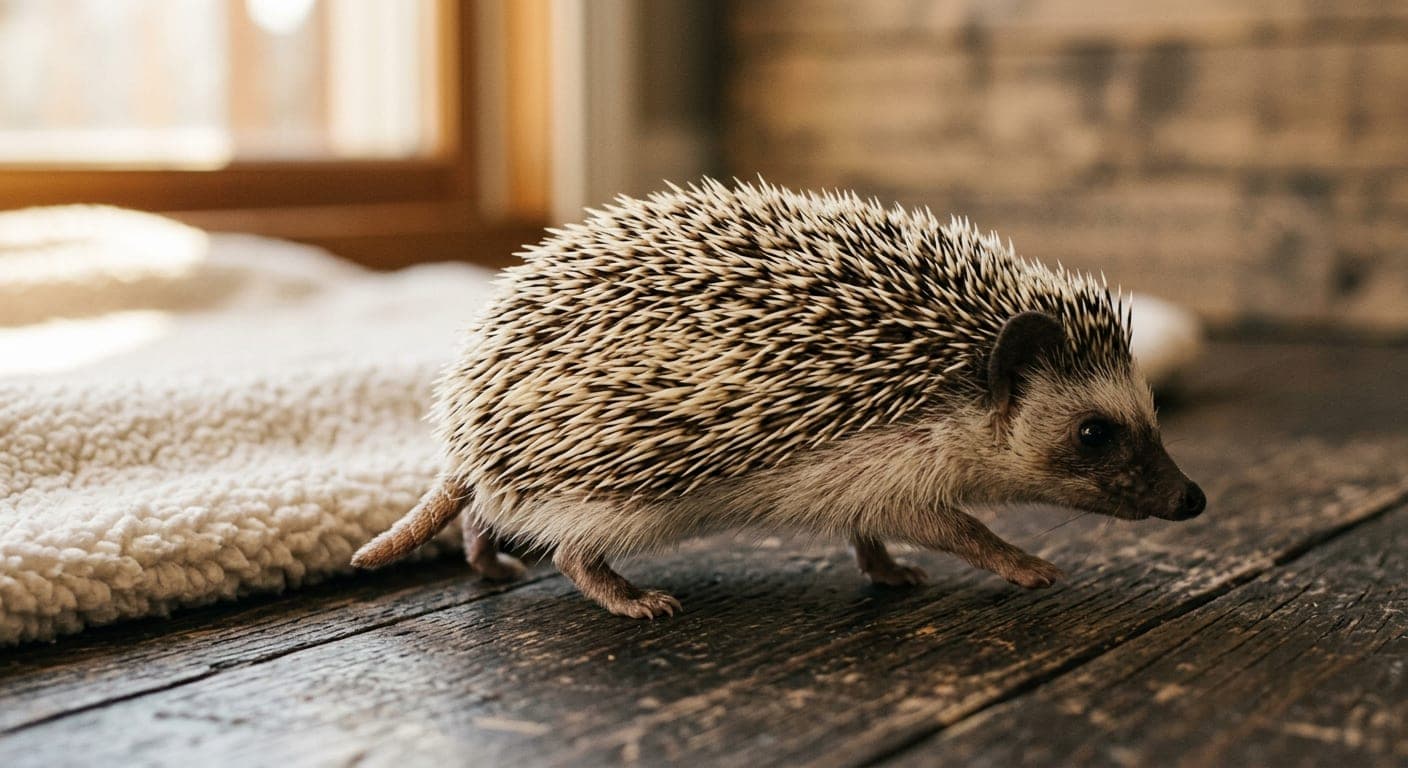
About an inch · hidden under the quills · easy to miss
Yes, hedgehogs have tails. Most people don't notice because the tail is small (about an inch on an African pygmy) and hidden beneath the rear quills. You can usually only see it from the side, when the hedgehog is walking on a flat surface, or in those rare moments when they sit upright and the rear quills shift.
It's one of those features that sounds like it shouldn't exist on an animal as round and spiny as a hedgehog. But it's there.
What the tail actually looks like
An African pygmy hedgehog tail:
- Length: Roughly 1 to 1.5 inches (2.5–4 cm) in an adult
- Color: Pinkish or grayish skin, sometimes with very fine fur
- Shape: Tapered. Wider at the base, narrowing to a small rounded tip
- Texture: Smooth or finely furred, depending on the individual
- Position: Emerges from the rear, pointed downward at a slight angle
Compared to a mouse tail or a rat tail, a hedgehog tail is much shorter and stubbier. There's no whip-like motion, no curling, no significant range of movement. It mostly just exists.
Why most people don't see it
Three reasons:
The viewing angle. The most common way people see a hedgehog is from above. Looking down at the spiny back. The tail emerges from the rear, pointing slightly down, so it's hidden by the rear quills from this angle. You have to look at the hedgehog from the side, or from behind, to see it cleanly.
The quill coverage. The hedgehog's quills extend down their sides and meet at the rear. The tail emerges from a small unspined patch just below the rear quill line. When the hedgehog is at rest, the quills can drape over the tail area.
It barely moves. A cat's tail or a rat's tail moves visibly. They whip it, curl it, wag it. A hedgehog's tail mostly just sits there. There's nothing dynamic to catch your eye.
If you want to see the tail clearly: watch your hedgehog walk on a flat fleece liner. The tail emerges visibly as they move, tracking just below the rear quills.
What it does (or doesn't do)
Honest answer: not very much. Hedgehog tails are essentially vestigial. A structure inherited from evolutionary ancestors but no longer serving major functions.
Things hedgehog tails might do:
- Minor balance during climbing. When a hedgehog navigates uneven terrain or climbs (badly) up a cage wall, the tail provides a small counter-balance.
- Scent-marking. Hedgehogs have glands near the base of the tail. Whether they actively use these for scent-marking territory is debated; if so, the function is minor.
- Thermoregulation in a very small way. The pinkish skin of the tail allows some heat exchange.
Things hedgehog tails don't do:
- Communication. Unlike cats or dogs, hedgehog tails don't signal mood. A happy hedgehog and a stressed hedgehog have tails in the same position.
- Defense. The spines are the entire defensive apparatus. The tail does nothing protective.
- Movement. No significant role in locomotion.
The hedgehog would function essentially the same without a tail. They have one because their evolutionary ancestors did, and there's been no selection pressure to lose it.
Tail length across hedgehog species
For the curious. The 17 hedgehog species vary slightly in tail proportions.
- African pygmy hedgehog (Atelerix albiventris): the pet species. 1–1.5 inch tail.
- European hedgehog (Erinaceus europaeus). Similar proportions. 1–1.5 inches in an adult that's much larger overall.
- Algerian hedgehog (Atelerix algirus): close cousin to the African pygmy. Similar tail.
- Long-eared hedgehog (Hemiechinus auritus). Slightly longer tail, 2–2.5 inches. Proportional to their lankier body shape.
- Indian long-eared hedgehog. Similar to long-eared.
Across the family, hedgehog tails are universally short. No species has a long whip-like tail; the longest are about 3 inches and proportional to a 12-inch body.
This is one of the defining features of the family Erinaceidae. Short tails, regardless of which continent the species lives on. Their evolutionary distant cousins (shrews, moles) sometimes have longer tails; hedgehogs do not.
Should you touch it?
Better not. A few reasons:
- It's sensitive. Unlike the quill-protected back, the tail area has no defensive coverage. Touch is felt more directly.
- Most hedgehogs don't like rear-end touching. It's an inherently vulnerable area, and even tame hedgehogs tend to pull away when you handle the tail or surrounding area.
- It can be hurt easily. At hedgehog scale, the tail is small enough that even gentle pressure can cause minor injury. Pinching, pulling, or accidentally grabbing it can hurt.
- There's no reason to. The tail doesn't need cleaning beyond what the hedgehog handles via self-grooming. You're not contributing anything by touching it.
If you happen to brush the tail incidentally during normal handling, no harm done. Just don't make it a thing.
Tail-related concerns (rare)
Things that occasionally come up about hedgehog tails:
Tail injuries
Rare but possible. A hedgehog who's been bitten by another animal or caught their tail in something can have minor tail injuries. Small cuts, swelling, sometimes infection. Visible bleeding or swelling at the tail warrants a vet visit.
Tumors near the tail base
Older hedgehogs (especially females over 3) sometimes develop tumors in the lower abdominal or genital area. If you notice swelling or a lump near the tail base, get it checked by an exotic-animal vet.
Excessive grooming of the tail area
Hedgehogs self-groom occasionally, but obsessive licking or scratching of the tail area can indicate skin irritation, anal gland issues (rare), or parasites. Persistent attention to one body area is worth a vet check.
A note on hedgehog "no tail" depictions
You'll see lots of hedgehog illustrations, plush toys, and cartoons where the hedgehog clearly has no tail. The Beatrix Potter illustrations, the children's books, even some scientific drawings show a round spiny body with no rear protrusion at all.
This isn't accurate, but it's a forgivable simplification. The tail is small enough that artists either don't notice or deliberately omit it for visual cleanness. The real animal has a tail; the cultural image of the hedgehog often doesn't.
If you're drawing a hedgehog from life and want it to be anatomically correct, include a small tapered tail just below the rear quill line. It'll make the drawing slightly more accurate even if most viewers won't consciously register it.
What this all adds up to
Hedgehogs have tails. The tails are small, hidden under the quills, don't do much functionally, and don't need any owner attention.
Of all the questions new owners ask about hedgehog anatomy, "do they have tails" is the one most reliably answered with "yes, and you don't have to think about it again." Now you can.
Common questions
Common questions
How long is a hedgehog tail?
About 1 to 1.5 inches (2.5–4 cm) for an adult African pygmy. Hidden under the rear quills, so it looks like there's no tail at all from above. The European hedgehog has a similar-length tail. The long-eared hedgehog (a different species) has a slightly longer tail at 2–2.5 inches.
Why don't people see hedgehog tails?
The tail is short and points downward, partially tucked under the rear quills. From the most common viewing angle (looking at the hedgehog from above), the quills cover the area where the tail emerges. You can usually see it when the hedgehog walks across a flat surface or when they sit upright briefly.
Can I touch a hedgehog's tail?
Better not. The tail area is sensitive (no quills there to protect it), and most hedgehogs don't like being touched near their rear end. Pulling or pinching the tail can hurt them — it's small enough that even gentle pressure is meaningful at hedgehog scale. Let them keep it to themselves.
What does a hedgehog tail do?
Not much in modern function. Some balance during climbing, possibly some scent-marking via glands near the base, but mostly it's a vestigial structure inherited from their evolutionary ancestors. Hedgehogs would be functionally fine without one; they have one because their ancestors did.
Do baby hedgehogs have tails?
Yes, from birth. Newborn hedgehogs (called hoglets) have small visible tails before their quills come in fully. As the quills develop in the first weeks, the tail gets visually covered.
Related on this site
Sources
Sources
- Erinaceidae — hedgehogs and gymnures (taxonomy and morphology) — Animal Diversity Web, University of Michigan Museum of Zoology
- Hedgehogs — general anatomy and biology — Merck Veterinary Manual